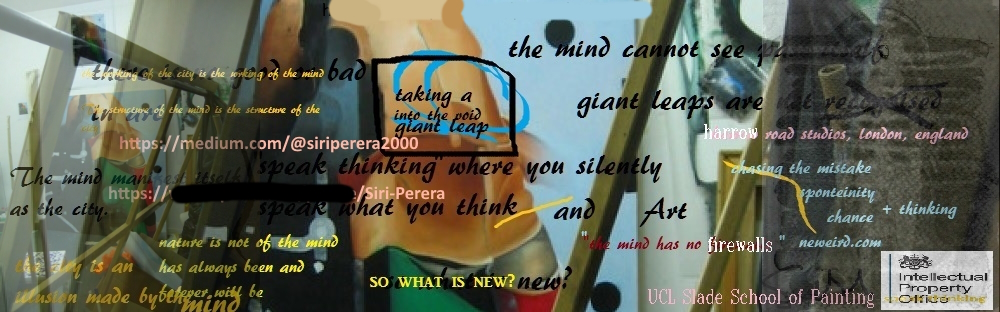
The Quantum Artist

Its has been quantum overload lately. Quantum design, quantum mechanico, quantum sports and the list is long. And there will be the quantum artist. But artists has always been quantum, like a mystic is quantum, like spirituality is quantum (like religion is dogma). The artist unknowingly or knowingly will eventualy find himself in the quantum space. That is the path of the process and if ‘Truth is ‘a pathless land’ (J. Krishnamurti) then the different types of art is a pathless process to the quantum space: consciousness or the quantum field. ‘First, consciousness is the ground of all being, and all objects of our experiences (of sensing, thinking, feeling, and and intuition) are quantum possibilities for consciousness to choose from’ (Amit Goswami – quantum physicist). The artist lives in this quantum field and makes his art. The quantum field, that universal database, contains all that is known AND unknown. In quantum mechanics, nothing actually exists UNTIL IT IS OBSERVED. When an artist chooses to manifest his observation in his painting say, he creates that reality, not only for himself, but for all those who tries to understand his art. An aura exists around his work, his thinking. But the artist has the choice to choose from the known or the unknown from this quantum field consciousness. The ‘front line of art’ moves forward only when he works from the unknown. The ‘new’ add to the old world and enlightens it with a discovery. ‘If we choose what is known, what is conditioned in us from prior experiences, we are choosing from our ego-consciousness.’ (Amit Goswami) You can see how the Self can drive itself from a single place in consciousness producing work that is already known. Remember, nothing actually exists UNTIL IT IS OBSERVED but you keep producing the same observation over and over again. Collectors require this of an artist to make sure their invesment will make a profit. Hence the whole art space, that frontline of art remains ‘stagnant’. ‘Looking for the new in the quantum consciousness requires quantum leaps (movement from point A to point B without going through intermediate steps), nonlocality (signalless communication), and tangled hierarchy (casual relationships of circularity)’ (Amit Goswami). Remember the mystics did not need the jargon to find the Truth. They did it only through observation. And the mystics got there before the scientists found themselves trapped in the quantum net. Only one-pointed observation is required. And this is the main tool of the quantum artist who works in the unmanifested quantum field manifesting the NEW through observation.

Siri Perera

Related Images:

The New Purpose For The Arts In Difficult Times

Friday, 15 May 2009 (THE INDEPENDENT newspaper, London)

Grave new world: There’s a sombre new mood in the arts world

by David Lister

…Linking the art that affects us and that we seek out to the economic recession is a dangerous science. In reality, such links can amount to little more than instinct and deduction. And yet… Do fears of financial meltdown, fears of redundancy, fears of a breakdown in society make us more contemplative? Contemplative of our own security, our own place in the world? Contemplative of our relationships with our fellow human beings? Contemplative of our mortality? The answer is surely yes.

I became even more certain of it this week, when I sat in a full house at Waiting for Godot. This best double act in English literature, with their music hall allusions, will always get laughs. But I could not fail to notice how the audience, more than in previous productions I have seen, seemed to feel the pain of the two tramps, seemed to ponder Beckett’s existential parable. The laughter was muted; the contemplation on the purposelessness of life almost audible.

Great art can and should reflect the times we live in, as great art has something to say about all times. But the times we live in can also determine the art we seek out. In this particular time of recession, financial and political instability, with the integrity of our most notable institutions questioned as never before, we seek out art that has real questions to ask. We seek out art that tries to make sense of the senselessness of existence. We seek out art that is full of ambiguity. We seek out art that helps us strive to understand.

If the silver lining of the recession is a hunger for more serious art, it is a silver lining unlikely to be mentioned in Parliament or in financial reports. But cultural history will not understate its sign.

Read the full article here…

Related Images:

Meme ‘gene’ And The Artist Via Richard Dawkins

“We need a name for the new replicator, a noun that conveys the idea of a unit of cultural transmission, or a unit of imitation. ‘Mimeme’ comes from a suitable Greek root, but I want a monosyllable that sounds a bit like ‘gene’. I hope my classicist friends will forgive me if I abbreviate mimeme to meme. … Examples of memes are tunes, ideas, catch-phrases, clothes fashions, ways of making pots or of building arches. Just as genes propagate themselves in the gene pool by leaping from body to body via sperms or eggs, so memes propagate themselves in the meme pool by leaping from brain to brain via a process which, in the broad sense, can be called imitation.” (Dawkins, the selfish gene, 1976, p 192).


Perhaps that is why only those ideas that are close to the front-line af Art are accepted into the ‘art pool’ and those that are too far out will seem strange and alien and rejected. We have survived and evolved to being what we are today by being good imitators. Here is a meme idea for you to propagate. We should look at work that is obsercure and new-weird as being enlightening possibilities by ‘choiceless observation’ rather than meme thinking. Referencing is encourage in all our ideas and work so we are constanly working off the past. Creation comes with no time. It is an insight, spontaneous, in an instance without thinking-time to alter and manipulate the original image. It is a kalichakra process. If Art keeps living off its past it will always be a slave to what already exists. Just as we evolved as imitators not very far away from yesterday in anything we do. If we don’t break this chain by being aware of ‘what is’ and recognise that work does not have to look like yesterday to be good, then perhaps we can swing the meme-gene by its tail back to the past and it would have met its end and tomorrow will be new.

Siri.

Related Images:

Influences On ‘Art of the Invisible’ Also Invisible In Contemporary Art History

Theosophy and Art
by
Prof. John Algeo

One of the most noteworthy instances of influence by theosophical thought on modern culture is the extent to which the founders of modern art, and especially nonrepresentational or abstract art, were consciously affected by the teachings of the Society[iii]. A major exhibit showing the influence of theosophical and allied ideas on modern art, The Spiritual in Art: Abstract Painting 1890-1985, was presented at the Los Angeles County Museum of Art, the Museum of Contemporary Art in Chicago, and the Gemeentemuseum in the Hague during 1986-87.[iv]

Artists who were influenced by theosophical and allied ideas include Jean Arp, Giacomo Balla, Joseph Beuys, Emil Bisttram, Serge Charchoune, Jean Delville, Theo van Doesburg, Arthur Dove, Marcel Duchamp, Paul Gauguin, Lawren Harris, Marsden Hartley, Jacoba van Heemskerck, Johannes Itten, Paul Klee, Yves Klein, Hilma af Klint, Franz Kupka, Kazimir Malevich, Brice Marden, Mikhail Matiushin, Georg Muche, Georgia O’Keeffe, Gordon Onslow-Ford, Jackson Pollock, Richard Pousette-Dart, Paul Ranson, Odilon Redon, Paul Serusier, and Jan Toorop.

Most significant perhaps are two giants of modern art, Wassily Kandinsky and Piet Mondrian. Kandinsky’s manifesto, Concerning the Spiritual in Art, is heavily indepted to H. P. Blavatsky and Theosophy, and his early efforts to free himself from the representational mode of painting were deeply influenced by the book Thought Forms by Annie Besant and Charles W. Leadbeater. Piet Mondrian was a long-time member of the Theosophical Society, and the whole body of his work is an effort to express certain fundamental theosophical concepts relating to the polarity of spirit and matter and the threefold nature of the ultimate world-stuff. (For more on these and other artists, see also The Spiritual Image in Modern Art, compiled by Kathleen J. Regier, Quest Books, 1987.)

In addition to the masters of abstract art, a number of symbolic painters have expressed theosophical themes. Noteworthy among them is Nicholas Roerich. The symbolic school of painters is no longer highly regarded by many art critics, and Roerich has shared their general decline in artistic reputation. However, Roerich’s paintings are prime examples of their genre and form a coherent whole with his other work, specifically his writings. Roerich was a mystic and was prescient, if not clairvoyant. His work, which has been praised for “an intense feeling for the epic dimensions and mystery of nature,” is a visual statement of some basic theosophical ideas.

The artist and architect Claude Bragdon, long-time and active member of the Theosophical Society, was interested in a variety of theosophically related subjects, including speculation on the nature of the fourth dimension. His analytical writings and visual productions became an influence in modern art.[v]


NOTES

[iii] That influence has been no secret. It has been dealt with, for example, by Sixten Ringbom, “Art in ‘The Epoch of the Great Spiritual’: Occult Elements in the Early Theory of Abstract Painting,” Journal of the Warburg and Courtauld Institutes 29 (1966): 386-418 and The Sounding Cosmos, Acta Academiae Aboensis, ser. A, 38 Abo, Finland: Abo Academy, 1970); Gerrit Munnik, “The Influence of H. P. Blavatsky on Modern Art,” In H. P. Blavatsky and “The Secret Doctrine”, ed. Virginia Hanson (Wheaton, IL: Theosophical Publishing House, 1971); an exhibition and catalog, Art of the Invisible (Jarrow: Bede Gallery, 1977); and Rose-Carol Washton Long, Kandinsky: The Development of an Abstract Style (Oxford: Clarendon, 1980).

[iv] The catalog of the exhibition is a collection of essays on aspects of the esoteric in modern art (New York: Abbeville, 1986).

[v] Linda Dalrymple Henderson, The Fourth Dimension and Non-Euclidean Geometry in Modern Art (Princeton, NJ: Princeton Univ. Press, 1983).

The segment above was taken from the main article: http://www.austheos.org.au/tsia-article-theosophy-and-the-zeitgeist.html


Related Images:

When We Encounter a Superior Work of Art…

1) …whether it be a poem, a painting or a piece of music, we experience an overflowing of emotion and a sense of fulfillment, a feeling of the expansion of the self, as if we had soared up to the heavens in accord with the subtle rhythms of the Universe. (book: Space and Eternal life; a dialogue between Chandra Wickramasinghe (astronomer) and Daisaku Ikeda (Buddhist Scholar).

2) The “subject” of a painting, if explicit, may well be a distraction: it has been argued that plastic qualities are all that count, and we take refuge in anecdote at our peril. Whether or not this is universally true, Hilton’s work constitutes one of the best arguments for believing it. (Roger Hilton: driven to abstraction by John Russell Taylor / from The Times (UK) August 12, 2008)

3) I coincidently came across this article in ‘The Times’ on the day I was going to the Serpentine gallery to see the work of Gerhard Richter. I liked GR because he did not keep to just one type of form but could go from photo realism to abstraction. He seemed to me constantly exploring and taking chances, like John Hoyland would in his paintings. In this series of paintings he went back to form he had done more than 40 years ago. 4900 Colours: Version II, are 49 painted panels, mounted on aluminium. The review isn’t good in that it was suggested that the work was dull and it was machine like. But looking at the range of Richter’s work you might think that that was what he was trying to put across. There is no good or bad in art. They all belong to the front-line of art. They all contribute to what is true in the arts. And should be valued the same for its contribution. Who says that art has to be always whoopy or yahoo.com. If it captures the opposite then it has manifested possibilities that could exist. It tells the story of the organic whole. Taking only part of the article will do it injustice so here is all of it below:

From The TimesSeptember 23, 2008—by Michael Glover

gerhard_richter.jpg

The Dresden-born German artist Gerhard Richter is best known for his hauntingly strange, photography-based paintings, works that often seem to hover somewhere between the documentation of everyday life, and some Dantean netherworld of haunted beings. At the Serpentine Gallery in Kensington Gardens, he has returned to an earlier manner of pure abstraction, the beginnings of which he first developed more than 40 years ago, when he made paintings based on industrial colour charts.

Here, in a show entitled 4900 Colours: Version II, are 49 painted panels, mounted on aluminium, each one a seemingly random variant upon the next. Each panel is 97cm square, and each of these panels contains small squares of pure colour – yellow, orange, red, blue, purple, green, etc. The colours themselves are bright, glossy and rowdy – they shout back at us like reflective household enamels, flawlessly applied.

There is no iconography here, not even the merest hint. Nor is there any of the moody, introspective sensitivity of a Rothko, or indeed any evidence of the personal touch. The panels lack texture, or any element of unevenness. They look smoothly unauthored, as if some machine brought them into being – a computer, for example.

The colour combinations are, in part, randomly generated; the way in which the paintings are displayed, on the other hand, has been determined by the human eye. They are all rigidly squared up to each other; one of the walls is a mirror image of its opposite.

Relentless abstraction of this kind has severe limitations. When the elements don’t challenge each other rhythmically in some way, the surfaces can look inert and unaffecting. When the colour combinations look crude and randomly chosen – as they do here – we don’t feel anything about them. Other than that they seem lacking in finesse, charm or sophistication of any kind.

When colour is used by any artist – Matisse, Bonnard or Richter – we want to see those colours working with each other in such a way that we begin to think differently about the world. This does not happen here. This is an art about the spurious autonomy of art-making; an art about the extinction of any idea of the personal. Unfortunately, the very idea is an absurdity. Man is not a machine. And man should not pretend to make art as if he were a machine. In that direction lies overwhelming dullness and the extinction of wonder.

Forty years ago a much younger and more outspoken Richter said that the authority of painting might legitimately come to challenge the authority of the priest or the philosopher. Not this kind of painting, though. In competition with this kind of painting, religion and philosophy win by several furlongs.

Serpentine Gallery (020 7402 6075) to November 16

4) Fré Ilgen artist – theorist
“The vastness of the cosmos with the planets and the microscopic world of particles define us and our perception of life. To me, creating art is a way to find out what this means.”

Related Images:

Patchouli & Kalichakra

The Kalichakra series is to look into that aspect of everyday matters that is bound and unbound by time. Kalichakra is everything that is timeless, untimebound or out of the realm of time. Its opposite is time and everything that is under the influence of time. This series was to look more closely into that aspect of us that is time bound and untimebound. It is taking aspects of painting that play a part in composition building and giving it prominence. The idea here is not to question the thought when it comes up but as to what to do next: to not allow the observation to turn in your mind with time. A Kalichakra painting is a painting that is out of the realm of time and you come to it by observation and from the moment. It is to experience the untimebound process of creation.
The Patchouli series was to capture the time around the sixties when it was a period of experimentation, fun and color. So I used it as a ‘tag’ to bring out the same qualities in the composition of the painting.
The Kalichakra paintings and the Patchouli series somehow compliment each other in content as they represent experimentation, creation and looking for the new.

Related Images:

Can Thinking Be Creative?

From the Krishnamurti Foundation

…a mind has to penetrate or be in such a state when the mind is not a slave to thought. After all, all thought in time is invention; all the gadgets, jets, the refrigerators, the rockets, the exploration into the atom, space, they are all the result of knowledge, thought. All these are not creation; invention is not creation; capacity is not creation; thought can never be creative because thought is always conditioned and can never be free. It is only that energy which is not the product of thought that is creative.

Creative Energ—The Book of Life (June 5)

Related Images:

A Painting Unbound By Time.

Towards a painting unbound by time.

The Kalichakra series is to look into that aspect of everyday matters that is bound and unbound by time. Kalichakra is everything that is timeless, untimebound or out of the realm of time. Kalachakra its opposite is time and everything that is under the influence of time. This series was to look more closely into that aspect of us that is time bound and untimebound.

Certain assumptions have to be made: the purest mark that is made is when time is not figured in its making. For example, when an insight pops up, the idea at its purest, is then manipulated by thinking and with time is changed from its original form. Time bound aspects in a composition can be seen as those deliberate aspects of the composition where planning is involved. The coming together of a painting because of planning. A kalichakra mark that is timeless on the canvas, to me, is one that is made, as soon as it comes to you. There is no prior planning, or an idea in the works, before a painting is started. A Kalichakra painting is made only when you come to your canvas and the first mark is made with no prior idea of what is to come. It is almost the purest form of spontaneity and allowing chance to create the painting. It is the best tool I feel for finding a composition that is new. It is taking 2 aspects of painting that plays some part in composition building and giving it prominence.
The idea here is not to question the thought when it comes up as to what to do next.

But I know the compositions will be quirky and strange perhaps to the viewer. But an image untainted by time through thought is a one off original. Thought is conditioned and it gets its information from the past, which is not new. But a Kalichakra painting is a painting that is out of the realm of time. In my paintings now you can identify parts that are untimebound and parts where the original insight has been turned over and they both sit next to each other – for now.

Related Images:

Abstraction and Theosophy

Art, Kandinsky, and Self-transformation

by Dr. John Algeo

Dr. John Algeo is international vice president of The Theosophical Society, and is Professor Emeritus at the University of Georgia, where he was Alumni Foundation Distinguished Professor of English until his retirement. He has been a Fulbright Research Fellow and a Guggenheim Fellow at the University of London. He is a past President of the American Dialect Society, the American Name Society, and the Dictionary Society of North America. He was editor of American Speech, the journal of the American Dialect Society, for ten years and is the author of numerous academic books and articles dealing with the history of the English language, British-American differences, and current usage, most recently the forthcoming Cambridge University Press book British or American English? A Handbook of Word and Grammar Patterns. He is author of the book Reincarnation Explored, co-author of The Power of Thought, and editor of The Letters of H. P. Blavatsky and of the forthcoming new edition of G. R. S. Mead’s Echoes from the Gnosis. He has been the editor of the Quest magazine and presents Theosophical courses and lectures around the world.

Wassily Kandinsky, one of the greatest artists of the twentieth century, is known as the father of modern abstract art. Some art critics think that, because abstract art does not depict physical objects, it is non-representational that is, it does not depict anything but is concerned solely with technique: with line, colour, and shape. But that is not what Kandinsky thought. He maintained that abstract art represents the inner side of reality rather than the outer form, the esoteric rather than the exoteric. And he also maintained that because abstract art is concerned with the inner side, it can be a means for self-transformation. Given his view of the purpose of art, it is not surprising that Kandinsky was deeply influenced by Theosophy.

Kandinsky wrote a manifesto for abstract art, called Concerning the Spiritual in Art (Uber das Geistige in der Kunst). In it he showed something of the influence Theosophy had on him by a reference to both Theosophy and H.P. Blavatsky:

Madame Blavatsky was the first person, after a life of many years in India, to see a connection between these ‘savages’ and our ‘civilization’. From that moment there began a tremendous spiritual movement which today includes a large number of people and has even assumed a material form in the Theosophical Society. This society consists of groups who seek to approach the problem of the spirit by way of inner knowledge. The theory of Theosophy which serves as the basis to this movement was set out by Blavatsky in the form of a catechism in which the pupil receives definite answers to his questions from the theosophical point of view [The Key toTheosophy,1889 ].

Theosophy, according to Blavatsky, is synonymous with eternal truth.

In his manifesto for abstract art, Kandinsky set forth a number of strikingly Theosophical ideas, of which seven are mentioned here.
I. Spirit or Inner Reality and Subtle Worlds

By the word ‘spiritual’ in the title of his book, Kandinsky meant ‘conscious, aware, purposeful, meaningful’ in contrast to what he called the ‘nightmare of materialism’, which he associated with despair, ‘lack of purpose and aim’, atheism, positivism in science, and naturalism or realism in art. For Kandinsky, naturalistic, representational art depicts only the surface appearance of things and thus loses the inner meaning that he sought to express in his abstractions.

Kandinsky also posited the existence of subtle worlds of matter, in which feelings and thoughts have form and existence as material entities: ‘Thought … although a product of the spirit, can be defined with positive science, as matter, but of fine and not coarse substance.’

Kandinsky’s paintings fall into four periods, partly reflecting their kind of meaning and corresponding to the four planes of human existence recognized in Theosophy:

1. physical, objective paintings that are impressionist or symbolic (before 1910).

2. emotional, abstract paintings of two sorts: (a) improvisations (‘unconscious, spontaneous expression of inner character, the non-material nature’ that contain no recognizable objects, but coloured shapes that express feelings) and (b) compositions (‘an expression of a slowly formed inner feeling, tested and worked over repeatedly’ that include recognizable objects, but ones that have been ‘stripped’ and ‘veiled’) (1910s).

3. mental, geometrical paintings from the Bauhaus period (1920s).

4. intuitional, biomorphic paintings (1930 and after).

2. Meaning and Purpose

Everything in the universe has meaning and purpose in it: ‘It is never literally true that any form is meaningless and “says nothing”. Every form in the world says something. But its message often fails to reach us, and even if it does, full understanding is often withheld from us.’
3. The Inner Life and the One Life

Kandinsky thought that all things, even supposedly dead matter, are vital and alive. Thus he praised the French painter Cezanne for his perception of the inner life of things: ‘Cezanne made a living thing out of a teacup, or rather in a teacup he realized the existence of something alive. He raised still life to such a point that it ceased to be inanimate. He painted these things as he painted human beings, because he was endowed with the gift of divining the inner life in everything.

The casual reader might mistake those words for metaphor. But Kandinsky intended them literally. Cezanne did not simply paint a teacup with such skill that it seemed to be alive – that is not what Kandinsky is saying. Rather he says that Cezanne ‘realized the existence of something alive’. Cezanne captured on canvas something real – the life of the ‘inanimate’ because ‘he was endowed with the gift of divining’ it. Teacups, like all objects, have a life in them. Only the diviner, the seer, can perceive it. As Kandinsky put it in an essay, ‘On the Question of Form’, ‘Even dead matter is living spirit’.
4. Evolution and the Teachers

Kandinsky viewed history as cyclical, a succession of periods of culture, each with its own unique style of art and its own unique characteristics. In the course of cyclical history, all Nature is evolving towards greater consciousness. Kandinsky said that, in the process of evolution, some human beings have developed ‘a deep and powerful prophetic strength’ and ‘a secret power of vision’; those advanced souls point the way to others. Kandinsky likened humanity to a triangle whose base consists of the mass of humanity. At the apex of the triangle are a few beings, and ultimately often a single one: ‘His joyful vision cloaks a vast sorrow. Even those who are nearest to him in sympathy do not understand him. Angrily they abuse him as charlatan or madman.’ Despite the abuse and rejection, the teacher at the apex, by personal effort, succeeds in inspiring and motivating those below, so that eventually they rise towards his position. In turn they inspire those still lower in the triangle to follow, so that eventually the entire triangle moves upwards – all as the result of the labour of the few or of the one with vision at the top.

Kandinsky’s triangle of humanity is Theosophical in two ways. First, it envisions humanity as consisting of persons at different levels of progress, at different stages of spiritual evolution. And second, it envisions each level of humanity as aiding and assisting those who are less advanced, helping them to progress, along with the self-sacrificing individual of sorrows, the Bodhisattva, at the top, who lives only to raise the rest of humanity to greater spirituality – that is, to greater self-awareness.
5. Progressivism

The consequence of the upward movement of the triangle and the labours of the Bodhisattva-s at its apex is the gradual improvement of the human condition. Kandinsky quoted with approval Blavatsky’s vision of the future betterment of humankind at the end of The Key to Theosophy:

The new torchbearer of truth will find the minds of men prepared for his message, a language ready for him in which to clothe the new truths he brings, an organization awaiting his arrival, which will remove the merely mechanical, material obstacles and difficulties from his path.

And then Blavatsky continues: ‘The earth will be a heaven in the twenty-first century in comparison with what it is now’, and with these words ends her book. (Concerning the Spiritual in Art, 13-14).

For Kandinsky, the improvement of the world and the human condition is the purpose of art. That improvement can result only from an increase in self-awareness, that is, an increase in spirituality. Like Blavatsky, Kandinsky saw both universal and human history as governed by an evolutionary impulse that responds to purpose as well as to causes and that moves towards a preconceived end.
6. The Inner Necessity and Svadharma

Kandinsky believed that each person has an inner Notwendigkeit need, necessity, inevitability, essentialness which ultimately determines all outward forms and actions. This inner necessity or essentialness is what the Hindu tradition refers to as the svadharma of a being its self-nature or inner foundation. In The Secret Doctrine, Blavatsky speaks of it in these words: ‘The Universe is worked and guided from within outwards.’ In evolution, we move towards a goal; but the goal is set from within and it expresses our inmost nature. We transform ourselves in order to become that which we truly are.
7. Art as Yoga

Art is a kind of Yoga, the purpose of which is to further evolution: ‘ … we are fast approaching a time of reasoned and conscious composition …We have before us an age of conscious creation, and this new spirit in painting is going hand in hand with thought towards an epoch of the great spiritual’ (Motherwell). Kandinsky believed that art and thought together are becoming more self-aware and will serve to increase self-awareness. A time of significantly increased self-awareness is what Kandinsky means by ‘an epoch of the great spiritual’. That epoch of the great spiritual is a time of increased consciousness when humans will go beyond ordinary mental activity to reliance on the sort of reason and perception that Theosophy associates with buddhi. In The Secret Doctrine, maha-buddhi (literally, ‘the great spiritual ‘) is another name for what is also called mahat, or divine mind, which is the cosmic equivalent of self-consciousness in human beings (vol.1:p334,p451 ). Kandinsky anticipated a time when maha-buddhi, the great enlightenment or awareness, would be the normal state of consciousness; and he thought that art would play a role in bringing that time into being: ‘Painting is an art, and art is not vague production, transitory and isolated, but a power which must be directed to the improvement and refinement of the human soul -to, in fact, the raising of the spiritual triangle.’

Kandinsky can be called a Theosophical artist on several grounds. He was aware of Theosophical writings, particularly those of H.P. Blavatsky and of Annie Besant and C.W. Leadbeater, whose book Thought Forms influenced his painting (Ringbom). Thus his practice was influenced by Theosophical models. In addition, his theory of art reflects Theosophical concepts, both explicitly and implicitly. But Kandinsky was a Theosophical artist especially because his motive for the practice of his art was to improve the condition of all human beings by helping them in the process of self-transformation.§

References

1. Algeo, John, ‘Kandinsky and Theosophy’, in H.P. Blavatsky and The Secret Doctrine, ed. Virginia Hanson, 217-35, Theosophical Publishing House, Quest Books, Wheaton, IL, 1988.

2. Kandinsky, Wassily, Concerning the Spiritual in Art, trans. MTH Sadler, Dover, New York, 1977. Reprint of the first English translation, 1914.

3. Motherwell, Robert, ed., Concerning the Spiritual in Art., Wittenborn, Schultz, New York, 1947. Revision of the first English translation with changes supplied by Nina Kandinsky.

4 Ringbom, Sixten, ‘Art in “The Epoch of the Great Spiritual”: Occult Elements in the Early Theory of Abstract Painting’, Journal of the Warburg and Courtauld Institutes 29 (1966),386-418.

The Theosophical Society 2006
reproduced from ‘The Theosophist’ September 2004 (Vol 125 No.12), The Journal of The Theosophical Society, International HQ: Adyar, India http://www.ts-adyar.org

http://www.theosophical-society.org.uk

Continue reading

Related Images: