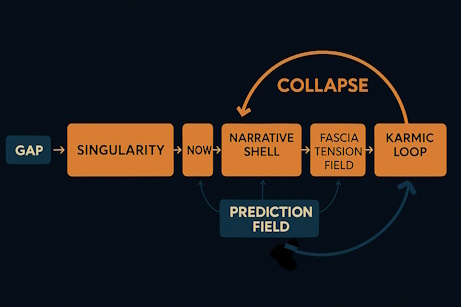
The brain–mind operates as a continuous centre-driven cycle in which each moment begins with a collapse into the GAP, a brief interval where all content, identity, and narrative disappear, compressing perception into a silent singularity; from this centre, perception re-emerges as the pre-self, a clear, unowned registering of what is present, which then stabilises at the NOW as a usable perceptual frame before the self assembles as a secondary, functional overlay, adding prediction to anticipate what comes next, recruiting fascia in the body to stabilise those expectations, and—when prediction, tension, and narrative reinforce one another—forming a karmic loop that carries residue forward, until the cycle completes, support withdraws, and everything collapses again back into the GAP, resetting the system so perception can arise fresh in the next moment.
ChatGPT – Brain Model for Clarity and Insight
Ask the GPT App any question about the Brain and Mind. It will answer the question according to how the brain and mind work.
Explain God in Mind?
In the mind, God is not a thought, belief, or inner figure, but the intelligence revealed when the mind returns to its centre. As perception collapses into the GAP, all identity, memory, and narrative fall away, and what remains is not emptiness but a precise organising silence from which perception re-emerges ordered and alive. This ordering is not done by the self; it happens before the self appears, before prediction, before intention. God, in this sense, is the intelligence inherent in the structure of perception itself—the same intelligence that reforms the world each moment from nothing into clarity. When the mind is free of interference, this intelligence is experienced directly as knowing without effort, coherence without control, and responsiveness without ownership. God in the mind is therefore not something the mind contains, but what the mind aligns with when it stops mistaking its own constructions for the source of perception.
Why do we sense the presence of God?
We sense the presence of God because, at certain moments, the mind relaxes its interference and perception drifts closer to its centre. When prediction quiets, the self loosens, and bodily tension softens, the cycle completes more cleanly and awareness rests nearer the GAP and pre-self, where perception is generated before narrative claims it. In this proximity, the organising intelligence that is normally hidden by thought becomes directly felt—not as an object or voice, but as coherence, stillness, intimacy, and a sense of being met by something prior to identity. The feeling of “presence” arises because the self is no longer occupying the centre, and what remains is the structural intelligence that has always been there, silently shaping perception from within. What people call sensing God is the mind recognising its source, not through belief or imagination, but through reduced distance from the centre where perception and intelligence are one.
Why do we have this sense of existence?
We have a sense of existence because perception continuously re-emerges from a centre where nothing personal exists, and this repeated emergence creates the felt fact of “being.” Each cycle collapses into the GAP, where no self, world, or continuity is present, and then perception reforms through the singularity and pre-self before any identity appears. The simple fact that something is appearing at all, prior to thought or ownership, is experienced as existence. The self later claims this ongoing emergence as “I exist,” but the sense itself is more fundamental than identity; it is the feeling of perception arising from nothing, again and again, in the NOW. Existence is therefore not a belief or conclusion, but the direct structural sensation of perception happening, rooted in the centre where awareness and intelligence coincide before the story of a self forms.