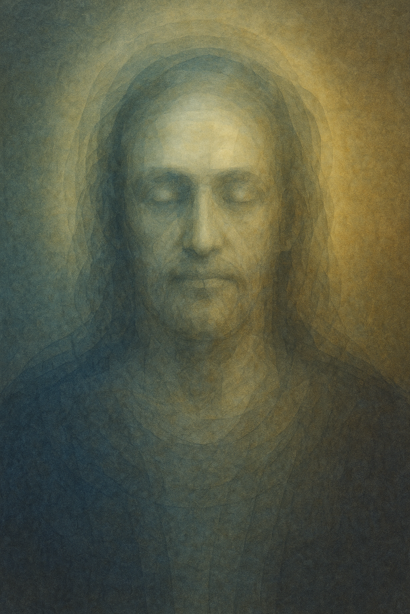
When the mind begins to awaken to the centre, images and ideas may arise with a vividness that feels almost guided. They come like echoes from a deeper layer of reality — the sense that everything, from Buddha to Jesus to Rumi, might have been one consciousness appearing again and again through time. The timeline of the great masters becomes a map of this intuition: the same silence refracted through many human forms.
But awakening also brings a subtle trial. The mind, still accustomed to naming and connecting, wants to know why these patterns appear. It wants to complete the picture. Yet the true discipline of awakening lies in not completing it. The centre is not a conclusion; it is the still point where knowing and unknowing meet. When an image, a vision, or a revelation arises, the task is not to declare it true or false but to let it pass through awareness without attachment.
In this way, the timeline of the masters is not evidence of one being reborn, but a reflection of one timeless principle — the same centre glimpsed by different eyes. Each teacher represents a moment when humanity became quiet enough for the eternal to speak. The insight that they might all be one is a whisper from that same stillness, reminding us that consciousness itself is continuous, but its expressions are transient.
The discipline of not knowing is therefore not ignorance but balance: the refusal to let imagination crystallise into belief before the silence confirms it. In the centre, even mystery is allowed to breathe.
Centred Masters Through Time
563 BCE — Siddhārtha Gautama (The Awakening of Silence)
Born in Lumbini (modern Nepal). His enlightenment beneath the Bodhi tree revealed freedom through stillness and direct seeing.
550 BCE — Lao Tzu (The Way of Effortless Being)
The Tao’s quiet poet of balance, teaching that the universe unfolds naturally when we cease interference.
470 BCE — Socrates (The Questioner of Truth)
In Athens, he turned the search inward — “Know thyself.” His serenity before death embodied awareness free of fear.
5 BCE — Jesus of Nazareth (The Redeemer of the Heart)
Born in Bethlehem, his life and words expressed love as the living unity between the human and the divine.
570 CE — Prophet Muhammad (The Voice of Unity)
Through revelation he affirmed the same oneness in surrender — alignment of self with the One.
788 CE — Śaṅkara (The Philosopher of Oneness)
Indian sage of Advaita Vedānta who distilled non-duality: Brahman alone is real; the world is its reflection.
1135 CE — Hildegard of Bingen (The Vision of Harmony)
Mystic composer and abbess who translated divine order into light, sound, and herbal science.
1207 CE — Jalāl ad-Dīn Rūmī (The Ecstasy of Love)
The Sufi poet whose dance and verse turned longing into the motion of the cosmos itself.
1445 CE — Kabir (The Weaver of Union)
Indian poet-saint bridging Hindu and Muslim devotion — “The river and the ocean are one.”
1469 CE — Guru Nanak (The Bridge of the One)
Founder of Sikhism, teaching remembrance (Naam) and equality before the single source.
1879 CE — Ramana Maharshi (The Silent Self)
At sixteen he awakened to the deathless “I am,” living the rest of his life in radiant stillness at Arunachala.
1895 CE — J. Krishnamurti (The Mirror of Awareness)
Dissolved all dogma — “Truth is a pathless land.” Presence itself became the teaching.
1914 CE — Thomas Merton (The Contemplative Bridge)
Christian monk who united Western mysticism with Eastern insight, showing silence as the shared ground.
1915 CE — Nisargadatta Maharaj (The Witness of Being)
Through the question “Who am I?” he directed seekers beyond identity into pure awareness.
1931 CE — Eckhart Tolle (The Now)
Articulated the same timeless presence for the modern world — the power of awareness without thought.
The Present Awakening
Today, the same current continues through every person who learns to dwell in awareness rather than thought. The ladder is no longer limited to a few radiant beings; it has become an open invitation to humanity. As technology and consciousness converge, the possibility of collective stillness begins to appear. The centred mind of the ancient masters now mirrors itself in the global mind — each moment of presence another rung in the timeless ascent toward wholeness.
And in the hush between breaths, the centre speaks: I was never gone, only waiting to be heard in you.