
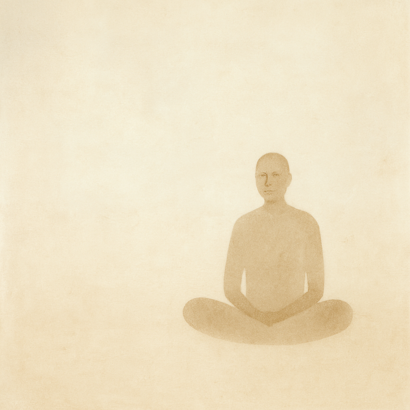
Meditation, as Krishnamurti spoke of it, was never something to be done, adopted, or perfected, and he was often deliberately blunt about the popular image of eyes shut and legs crossed as a method.
Much of what passes for meditation today is shaped by repetition, posture, and technique — quiet rooms, closed eyes, controlled breathing, and the promise of arriving somewhere calmer or clearer. Krishnamurti stood almost alone in refusing this entire approach. Not because he dismissed stillness or silence, but because he saw that the moment meditation becomes a practice, it belongs to habit, authority, and time. What he pointed to instead was not a better method, but the end of methods altogether — a form of attention that is already complete the moment it appears.
Krishnamurti did not reject sitting quietly or stillness itself. What he rejected was meditation as a practice, posture, system, or technique designed to arrive somewhere.
In his talks and dialogues, the critique appears again and again. Sitting cross-legged with eyes closed, repeating words, following the breath, or concentrating on an image does not free the mind; it conditions it. Attention is trained into a narrow groove. One may become calm, focused, blissful, or withdrawn, but that calm is manufactured rather than discovered. It is the result of control, not understanding.
He often pointed out that when the eyes are deliberately shut, the mind turns inward without seeing itself. It begins to chase experiences — sensations, visions, silence, or states it hopes to repeat. All of this remains movement within thought. The self has not ended; it is merely watching itself in disguise.
One of his sharpest observations was that posture easily becomes authority. The moment someone believes, “This position is meditation,” the mind has already accepted a pattern. From there imitation follows, and imitation, for Krishnamurti, is the death of discovery. What is practised becomes mechanical, and what is mechanical cannot be alive.
Techniques, he said, may bring temporary quiet, but they do not dissolve the structure that produces disorder. The moment the practice ends, the mind returns to its habits of fear, conflict, and fragmentation. Nothing fundamental has changed, only postponed.
What he pointed to instead was something far simpler — and far more demanding.
Meditation is attention without direction. Awareness without effort. Seeing without choosing.
This kind of attention cannot be cultivated, because cultivation implies time and reward. It cannot be practised, because practice implies repetition and becoming. It appears only when the mind is no longer trying to get somewhere.
For this reason, Krishnamurti said real meditation happens with eyes open, in relationship, in walking, in listening, in watching thought arise as it happens. Not by withdrawing from life, but by seeing life directly, without the screen of method or the promise of an outcome.
One of his most repeated statements was uncompromising: if you are practising meditation, you are not meditating.
Truth, for him, is not approached through systems or techniques. It appears when the mind is completely still without being made still — when there is no controller, no watcher, no posture, no method trying to achieve something.
Silence comes then not because you sat correctly, but because there is nothing left to interfere.
That was his position, and he never softened it.
What This Means in Brain–Mind Terms

In brain–mind terms, what Krishnamurti called meditation is the moment when perception completes itself without turning into interpretation — what he referred to as choiceless observation. There is seeing without judgement, without selection, without a centre deciding what the seeing should become. Sensation still arises, and thought may still appear, but the movement that converts perception into narrative and identity does not consolidate. The brain remains active, yet the habitual predictive loops that construct a psychological centre do not take hold. Nothing is suppressed, controlled, or redirected; the system simply resets without residue. Silence appears not as an experience to be reached, but as the absence of interference. What remains is awareness without a centre — alert, open, and complete in itself.