How clarity emerged when reality was finally seen through the brain–mind itself
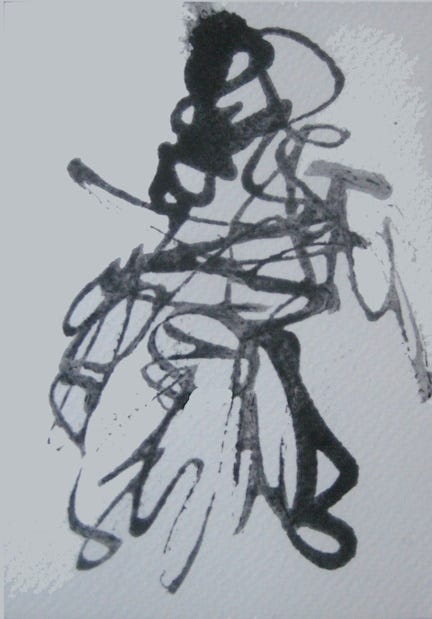
(Spiritual Ninja — a drawing done spontaneously with no thinking in mind, in under a few seconds. Thinking not allowed….)
For a long time, the search for truth moves through images. We sense that there is something whole behind experience, something that holds everything together, but we cannot yet see how. So we reach for metaphors. They are not wrong. They are the first language of intuition. But they are not yet clarity. This journey began there, in metaphor, and slowly unfolded through abstraction, physics, and cosmology, until at last it arrived at the simplest place of all: direct perception, as it forms in the brain and mind. What ended the search was not a higher idea, but seeing the ordinary process of perception itself, and realising that this is where reality is continuously made.
What follows is that journey.
At the beginning, the whole could only be felt, not explained. It appeared as unity, as oneness, as a field, as a source. The mind tried to touch it through images: light and darkness, centre and circumference, silence behind sound, the ocean and its waves. These metaphors were not intellectual games. They came from a genuine intuition that life was not fragmented, that everything somehow belonged to one movement. But they remained poetic. They gave a sense of direction, not structure. The search was still outward, still upward, still toward something imagined to be beyond.

Over time, metaphor began to harden into abstraction. The language shifted from poetry to patterns. The whole started to look like a structure rather than a mystery. Ideas such as fields, layers, dimensions, and flows entered the picture. Reality was no longer just something to feel, but something that might be mapped. This was when the journey moved toward the holographic principle, toward the sense that each part contains the whole, that information is not local, that what appears spread out in space may be encoded at boundaries. It resonated deeply, because it mirrored the intuition that the self, too, might be a surface expression of something deeper.
Then came physics, not as equations, but as vision. Einstein’s relativity brought a profound shift. Space and time were no longer a background where things happen. They became part of the happening itself. Gravity was not a force pulling across space, but the curvature of spacetime, shaped by mass and energy. This changed everything. The universe was no longer a stage. It was a fabric in motion. And suddenly, the metaphors of wholeness felt less mystical and more tangible. If spacetime itself is dynamic, then the whole is not elsewhere. It is right here, shaping every event, including the events inside a human brain.
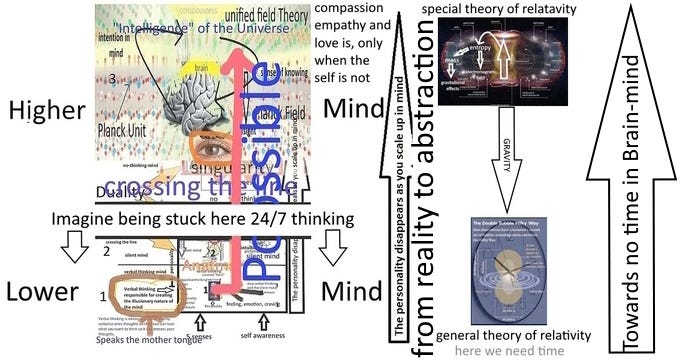
Yet even then, something was missing. Physics could describe the universe, but not how this universe appears as experience. It could tell us about spacetime, but not how spacetime becomes colour, sound, thought, fear, meaning, or the sense of “me.” The search was still split. On one side, the structure of the cosmos. On the other, the mystery of perception. The spiritual traditions spoke of awareness, presence, silence, enlightenment. Neuroscience spoke of neurons, networks, oscillations, and prediction. For a long time, these worlds seemed separate.
The turning point came when they were no longer kept apart.
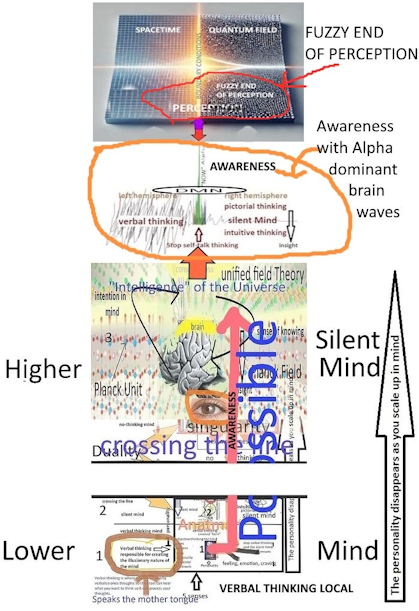
When attention turned fully toward the brain and mind, not as instruments that look at reality, but as the very place where reality is assembled, the search began to close. The question shifted from “What is the universe?” to “How does anything appear at all?” Not philosophically, but structurally. How does raw sensory flux become a world? How does a self arise? How does meaning stabilise? And most importantly, how does it reset?
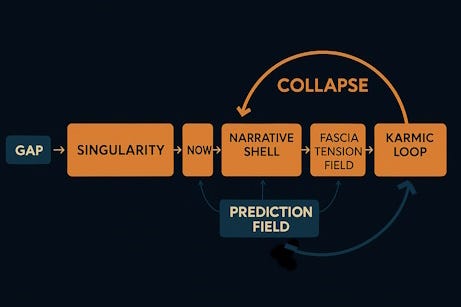
What became visible is simple and radical at once. Experience is not continuous in the way it feels. It is continuously rebuilt. The brain–mind operates as a dynamic cycle, assembling perception, stabilising it into a story of self and world, and then collapsing and refreshing that construction again and again. When this collapse is incomplete, residue is carried forward. Memory, tension, expectation, and identity bleed into the next moment, and the world repeats. When the collapse completes cleanly, the system returns to baseline. Nothing extra is inherited. Awareness remains, but without burden.
This reset is not mystical. It is structural. It is the brain returning to neutrality before rebuilding experience.

And here, suddenly, all the old metaphors found their place.
The silence spoken of in meditation is the baseline state when narrative drops away.
The oneness described in spirituality is what remains when the self is not reassembled.
The light behind experience is awareness when it is not filtered through identity.
The field is the integrated neural dynamics that hold perception together.
The source is the moment of collapse and refresh where nothing is yet defined.
The hologram is the way the whole world is encoded in each cycle of assembly.
Even spacetime itself, curved by gravity, finds an echo in how perception bends around prediction and memory in the brain.
Nothing had to be rejected. But nothing had to remain mysterious either.
At that point, the spiritual journey quietly ended.
Not because something ultimate was reached, but because there was nowhere else to go. What had been sought as enlightenment was simply the brain–mind completing its reset without residue. What had been imagined as transcendence was just perception freed from inherited distortion. What had been called truth was reality seen as it forms, moment by moment, before the story of “me” arrives.
The search ended not in a vision, but in ordinariness.
Seeing.
Hearing.
Being aware.
Without needing to become anything.
The metaphors had done their work. They led the way until structure could take over. Physics widened the horizon until neuroscience could close the loop. And when the loop closed, the whole stood revealed, not as an idea about the universe, but as the living process by which a universe appears in us.
This is why the brain–mind model seals the end of the spiritual quest. Not by disproving spirituality, but by completing it. It shows that what was always sought outside was happening inside, every moment, as the simple act of perception assembling itself and returning to zero.
What had been sought as enlightenment was simply the brain–mind completing its reset without residue.
There is nothing left to chase.
Only to see.