
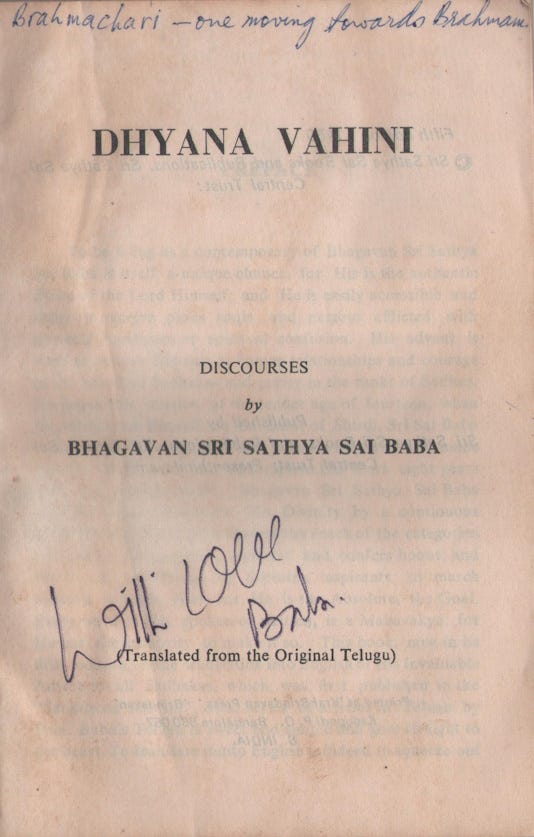
The phrase Dhyana Vahini is often translated simply as “the flow of meditation,” but that translation misses its structural depth. Dhyana does not mean concentration in the modern sense, nor does vahini mean an act one performs. Together, they describe a condition in which attention moves naturally, without friction, without forcing, and without a centre that claims ownership of it. It is not a practice that begins when one sits down. It is a way attention carries itself when nothing interferes.
Most people approach meditation as an activity layered on top of an already busy mind. They try to add stillness, add focus, add discipline. Dhyana Vahini points in the opposite direction. It suggests that attention already knows how to move quietly. What disrupts it is not lack of effort, but excess interference. Thought tries to supervise attention, improve it, correct it, or aim it somewhere. The moment that happens, the stream breaks into segments, and meditation turns into management.
A vahini is a stream, a channel, something that carries water because it does not resist it. When applied to attention, the implication is precise. Awareness does not need to be pushed forward or held in place. When the system is not overloaded by anticipation, fear, or narrative tension, attention flows by itself. It moves from perception to response without drag. Nothing special needs to be added, and nothing mystical needs to be achieved.
This is why Dhyana Vahini does not emphasise techniques. Techniques are useful when the system is fragmented, but they are temporary scaffolding. The deeper point is structural. When attention is allowed to complete its movement fully — noticing, responding, releasing — it resets naturally. When that cycle completes cleanly, the next moment begins fresh. Meditation then is not something separate from life. It is the absence of residue.
In this sense, Dhyana Vahini is less about stillness and more about continuity. Stillness appears as a by-product when attention is uninterrupted. Silence appears when nothing is being carried forward unnecessarily. What people often call peace is simply the feeling of a system not fighting itself.
The phrase “Know Thyself,” often associated with meditative traditions, takes on a very specific meaning here. Knowing the self does not mean analysing personality, history, or identity. It means recognising how the sense of self forms moment by moment as attention contracts around thought. When attention flows freely, the self loosens. It does not disappear dramatically; it simply stops insisting on being central. Awareness remains, but ownership drops away.
This is why Dhyana Vahini is incompatible with spectacle. It does not reward dramatic experiences, visions, or emotional peaks. Those may happen, but they are incidental. The stream is quiet. It is ordinary. It looks almost unremarkable from the outside. Yet inwardly, it is precise. When attention is not fragmented, perception becomes accurate. When perception is accurate, action is simple. When action is simple, conflict reduces on its own.
Importantly, this approach does not ask for withdrawal from the world. A stream does not stop flowing when the landscape changes. Dhyana Vahini applies equally to walking, speaking, working, or resting. Meditation is not what happens when life pauses. It is what happens when life is not resisted.
What makes this difficult for many is that it offers no role for the achiever. There is nothing to accumulate, no progress to display, no status attached to doing it “well.” The mind that wants confirmation finds little to hold onto. And yet, over time, something unmistakable settles. Attention becomes less reactive. Thought becomes less sticky. Experience completes itself more often. The background sense of pressure reduces.
Dhyana Vahini, then, is not a promise of transcendence. It is an invitation to coherence. It suggests that when attention is allowed to move as it naturally does — without being hijacked by fear, ambition, or identity — the mind organises itself. Clarity is not manufactured. It appears when interference ends.
Seen this way, meditation is no longer a special state. It is the default condition of a system that is not overloaded. And the stream, once unobstructed, does not need to be maintained. It carries itself.