
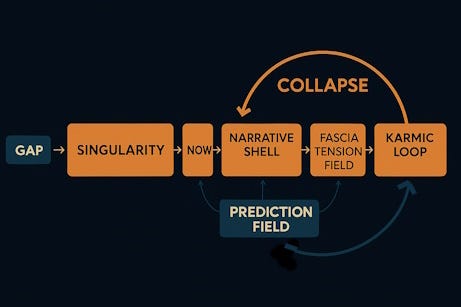
…….is a way of describing how experience, identity, and reality assemble moment by moment in the brain–mind.
At its core, it says this: perception does not begin with a self observing the world. It begins from a neutral baseline — zero — where raw sensory data and bodily signals arise before interpretation. Very quickly, the system inverts this process. Instead of seeing experience as forming, it flips the sequence and generates the feeling that “I am here, and I am perceiving something.” That flip is the inversion.
In normal functioning, this inversion happens so fast that it feels continuous and solid. The sense of a stable self appears first, and perception seems to belong to it. But structurally, the self is assembled after perception has already begun. The inversion hides this order.
The “zero” in Zero-Inversion refers to the brief reset point in each cycle — a reset where prediction, narrative, and identity momentarily drop out. If this reset completes cleanly, nothing extra is carried forward. Perception restarts fresh. If it completes incompletely, residue remains — memory, tension, expectation — and the next cycle repeats the past.
The reset cycle explains why suffering, repetition, and psychological friction persist: they are not caused by experience itself, but by repeated incomplete inversions where identity stabilises too early and hijacks perception. It also explains why clarity, ease, and what traditions have called enlightenment feel ordinary rather than dramatic — they occur when the inversion relaxes, and the system keeps returning to zero without residue.
In short, the Zero-Inversion Brain–Mind Reset Cycle describes how the brain–mind flips a living process into a felt self, and how allowing the cycle to return fully to zero restores clarity without effort.