There are moments that don’t fit into memory, explanation, or coincidence, yet refuse to be dismissed. They don’t point outward to an event, but inward to a question about ourselves. This is not a story about predicting the future, but about what it means to be a human system embedded in a living world, sensing far more than we consciously know. The experience of a natural premonition becomes the doorway into a deeper inquiry: what kind of organism are we, really?
It is not about predicting the future, but about what kind of sensing organism a human being really is.
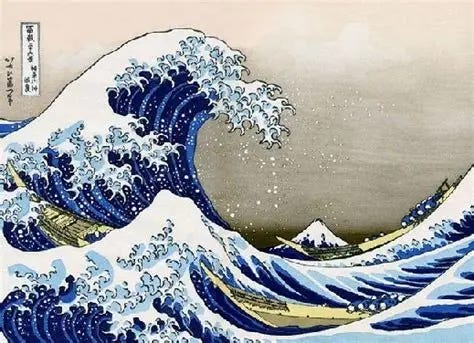
That question only became unavoidable for me after an experience I could not place anywhere in ordinary thinking. Months before the 2004 tsunami that rose off Sumatra and swept across the Indian Ocean, I carried a certainty that many people would die by a vast flood of water. Not as a fear. Not as imagination. But as a quiet, heavy knowing. When the event finally unfolded nine months later, the shock was not just at the tragedy itself, but at the recognition that something in me had already been aligned to it.
At the time, there was no model to hold this. No language. Only the raw fact that a natural event, external and impersonal, had somehow taken shape in my mind long before it appeared in the world. I could have dismissed it as a coincidence. But something in me knew that would be turning away from a deeper truth. So I took it seriously. Not as a gift, not as a power, but as a question.
How could this arise in a human being at all?
Years later, with the help of neuroscience and the unfolding of the brain–mind model, that question found a ground to stand on. What emerged was not an explanation of the tsunami, but an explanation of us.
In this model, perception does not begin in the head. It begins in the whole embodied field of the body, the fascia, the nervous system, and the environment we are embedded in. The brain is not a detached observer. It is the integrator of a living web. At every moment, vast amounts of nuanced information are flowing through us — pressures, rhythms, vibrations, micro-tensions, sounds, movements, electromagnetic noise, social patterns, environmental regularities. Almost none of this becomes experience. It is compressed at the reset, the GAP, and only a thin crest becomes the world we know.
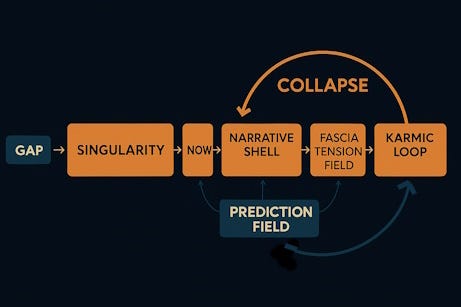
Most of the time, that compression is dominated by memory, habit, emotion, and self. The nuances of the world pass through us unnoticed, shaping us quietly from below our awareness.
But when the system is quiet, when residue is low, when the brain–mind is centred in the now, something else becomes possible. The compression can become clean enough for a deeper pattern in the world to surface — not as data, not as analysis, but as image, as form, as a sense of knowing.
In that light, what I sensed was not the future. It was not information sent backward in time. It was the direction the world was already leaning toward, written into present conditions far too slow and too vast for ordinary perception — the long accumulation of stress in the Earth, carried in innumerable minor disturbances of the crust, picked up as bodily nuance and then reasoned by the brain–mind into the form it could hold — a great flood, overwhelming force, and many lives lost.
The mind did not read tectonic plates.
It gave that pattern a human face.
The nine months between the sensing and the event are no longer the mystery. The mystery is that such a pattern could ever pass through a human system at all.
And that brings us back to the real centre of this.
This is not about prophecy.
It is not about special powers.
It is about recognising what kind of sensing organism a human being really is.
We are not sealed inside our skulls. We are porous. Embedded. Coupled to the world through a living web of body, fascia, nervous system, and environment. The cityscape we have built around us is not separate from this. It is an extension of it — an external nervous system that feeds back rhythms, stresses, signals, and structures into us every moment of our lives. We are continuously informed by the world, and by our own constructions of it, in ways we have barely begun to acknowledge.
Most of that information never becomes thought.
But it always shapes the reset.
It always biases what we become next.
Very rarely, when coherence is high and noise is low, a deep external pattern breaks through the surface and becomes visible to itself in us. When that later resolves in the world, we call it a premonition. But what it really reveals is not the future. It reveals the depth of our coupling to reality.
The tsunami was the trigger that forced this into view for me. Without it, I might never have asked the question. Without taking it seriously, I would not be here now, with a model grounded in neuroscience that shows how such a thing could arise — not as magic, but as the natural extreme of what the brain–mind is always doing: sensing, integrating, resetting, and rebuilding itself in intimate contact with the world.
So the meaning of that experience has slowly shifted.
Not “I saw what would happen.”
But: I glimpsed what we are capable of sensing.
And that may be the deeper invitation in all of this. To move from seeing ourselves as observers of a world, to recognising ourselves as participants in a field of unfolding, where the boundary between inside and outside is far thinner than we ever imagined.
Not about knowing the future.
But about finally beginning to know ourselves.