
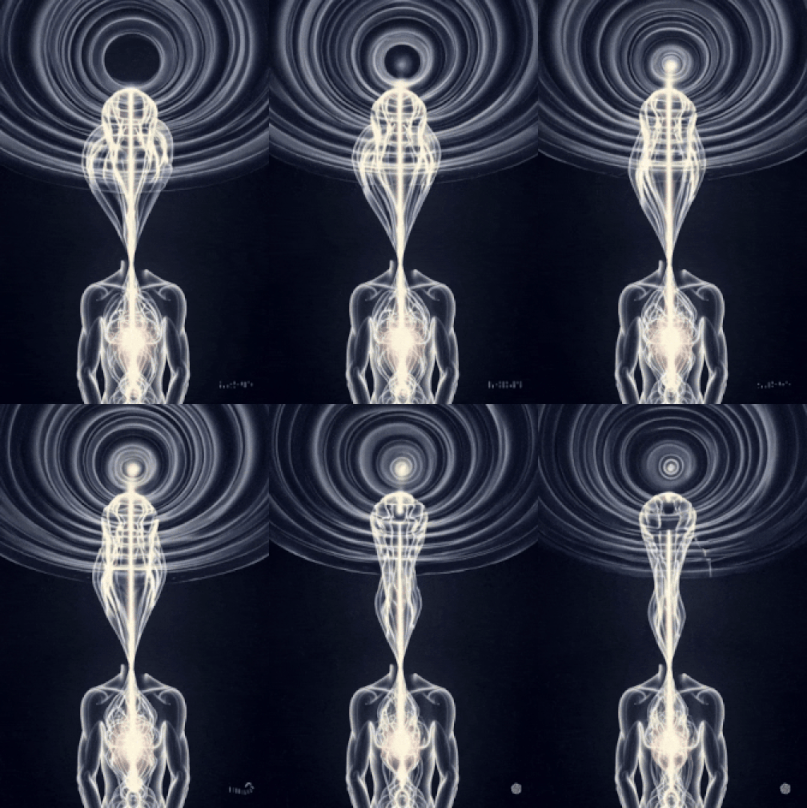
Much of spirituality has tried to describe a moment of stopping, a clearing, a return to something pure. Neuroscience, from another direction, has been uncovering how perception is assembled and released again and again in the living brain. This essay brings those two threads together. Not to claim a final mechanism, but to sketch what the reset might look like when we see it as a continuous, whole-body process — a collapse and renewal through which experience itself is born.
What the Reset Looks Like
If we try to picture the brain–mind reset, not as a diagram but as a process unfolding, it does not begin in the head. It begins in the body. In pressure on the skin, in the pull of muscles, in breath, posture, temperature, and chemistry. Signals rise continuously from this living field, carried by nerves and shaped by the web of fascia that holds the body as one piece. Nothing dramatic is felt, only a steady inward flow of state, as if the body is always reporting itself to something above.
As these signals reach the brain, they do not arrive as messages to be read. They arrive as timing, rhythm, and tension, merging into the ongoing activity of billions of neurons already in motion. Electrical currents surge and fade, and with them, faint electromagnetic traces ripple through the tissue. Some have suggested that these fields may help bind activity together, but whether field or current, what matters is that the brain is not collecting pieces. It is forming a single, momentary whole.
Perception assembles here. Predictions meet sensation. Memory leans forward. A sense of “me in a world” takes shape. For a brief instant, the pattern stabilises, and reality feels present.
Then it does not hold.
At the heart of the process, the organised activity begins to lose its grip. Synchrony spreads. Differences soften. The many rhythms that built the moment draw toward a common phase. What felt like a solid world thins. This is not a blackout, and not a gap in experience, but a subtle collapse — a return toward neutrality, where no particular story dominates.
In this collapse, everything that arrived from the body, everything that was predicted, everything that was felt or known, is taken up together. No signal remains separate. The system compresses its state, as if the whole moment is being folded back into a single quiet centre.
This is the reset.
Not an event you witness, but the condition that makes witnessing possible again.
From this near-zero, the process turns outward once more. Activity re-emerges. Patterns differentiate. Predictions rebuild. Sensation is taken up again. The sense of body returns, the sense of world returns, and with them the sense of self. A new moment stands where the last one dissolved.
And this is happening all the time.
Not once in meditation. Not at enlightenment. But hundreds of times each second.
When the collapse completes cleanly, little is carried forward. The new moment feels fresh, light, unburdened. When it is incomplete, residues remain — tensions, expectations, emotional weight — and the next moment inherits them, repeating familiar patterns.
Seen this way, the reset is not a spiritual achievement. It is the brain–mind doing what it is built to do: continuously dissolving its own constructions so that experience can appear again.
If one were to imagine it, it might look like a living current rising from the body into the brain, gathering into a luminous knot, vanishing into a quiet centre, and unfolding again into form. Not as light in space, but as the inner shape of experience itself.
Nothing is transmitted outward. Nothing is stored. Nothing is held.
The world appears, collapses, and appears again — and in that rhythm, a life is lived.
Could what we are seeing here be an image of what mind itself might be — not as a thing, but as the living field through which experience is continually formed, collapses, and begins again?