Not All Thinking Is Good Thinking

To me, I seem to feel that to pursue the new is probably the only reason I would want to paint. Because painting has the sense of total freedom to create and invent, yet to use the medium to document the past or the present social conditions seem to limit its power to illuminate the underlying Truth. A book can do a better job documenting. Chasing the new I feel gives one half a chance to catch a glimpse of that structure. Painting is totally free to create and manifest the future. Painting is totally free to map that unseen underlying structure of Truth rather than waste its power in documenting the structure of reality as you see it yesterday or today. A new idea has the power to transform. It allows the artist and the viewer to inhabit a new space. To step up into another space. Even science and genetics seem to think that the ‘self’ is ever forming. The ‘self’ is not anymore that unchanging entity that you can go back to, but rather one that is organic and forms itself continually with time, age. So you see the new, you experience it, you live it, you become it, and you pass it on. So if the process is in any way tainted, corrupted, the process is one of a destructive one. It will literally self-destruct. The software that drives this process is thought. If this has evolved to the extent where psychological thinking has gone askew, as is evident today, then each parent perpetuates the self-destructive element in the being. So you ask yourself why does destruction of human life seem to reoccur all the time in pockets of places around the world. Since the process is organic it can become good by living the good life. The good life gets programmed in the being and the good life is passed on, and the whole gets better with time. This will take time and will only come about if the software changes: psychological thinking has to cease, as it is a waste of energy. It is an evolution of other aspects of the mind. The process is an adaptation of a kind of thinking that is used for purposes of safety in the human being. Psychological thinking is operating on the back of the process of movement of the mind where it flickers from point to point when it has to consider its safety. Take for instance when you are driving your car. It goes from point to point considering its safety, left, right, rear view mirror, junction coming up, child on left kerb etc. It happens with such speed that if it were any slower or with gaps in it you would not be able to drive a car and live. It is useful thinking so to say. But the same process has come to adapt itself to psychological thinking. Illusions are created with psychological thinking, hatreds are formed, anger manifested as a result of these illusions created etc. So not all thinking is good thinking. Thinking has the power to condition one to becoming: a Muslim, a Hindu, a Christian etc and differences are created. Hatreds are formed. The killing starts. ‘Self’ destruction takes places. Because that ‘self’ that was created with time cannot sustain itself and has to self-destruct.

So what has this got to do with art? Thinking has to do with art. One has to be aware of thinking when art is made. One might be totally free to create art, to invent, but if one is still not free of the idiosyncrasies of the mind, then the work created is not pure and is not a reflection of the Truth. It is tainted by the illusions that are created by the mind. Making art of these illusions is making art of the past, it is cathartic, and it offers the viewer nothing new for him to step into. The new comes from insight, from the now, in an instance in stillness, not when time has had the opportunity to corrupt it.
Related Images:

Living the Process

You come to your form by living with the process of painting until you manifest and live in the space you created. Paintings are made from that space. siri.

Daily Quote Krishnamurti foundation November 26th 2007

To understand anything you must live with it, you must observe it, you must know all its content, its nature, its structure, its movement. Have you ever tried living with yourself? If so, you will begin to see that yourself is not a static state, it is a fresh living thing. And to live with a living thing your mind must also be alive. And it cannot be alive if it is caught in opinions, judgements and values.

Have you ever tried living with yourself?—Freedom from the Known (23)

Related Images:

Slade Paintings 2000

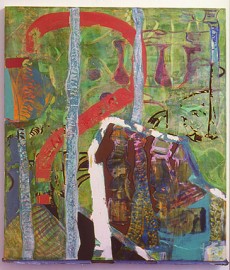
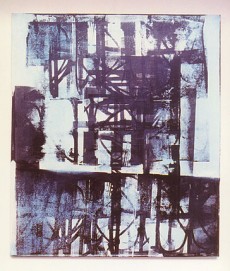
These paintings were done towards the end of 2000 at the Slade. Only now looking back I feel that the way I work now is as if I have come back full circle to these paintings after exploring other methods, ready to incorporate other discoveries with this early style. The ‘painting’ on the left is mainly screen-printing directly onto the canvas. The image on the screen was that of a single chair. The final image is as a result of multiple overlapping of the single image from the screen. Now you recognise it now you don’t sort of process: from realism to abstraction. And I think my interest of the image has always been at that point when realism crosses over to abstraction. Some of this and some of that, more of this and less of that, trying to capture the image at varying positions during that cross over. As you will see the little experience that I had in screen-printing had given me the chance to make a series of paintings trying to capture the shadow. I always thought that the image on the screen in the screen printing process had something about the intangible in it that I would one day like to use, and did so after the Slade. Capturing the intangible shadow into the tangible image.
The painting on the right was hand painted in layers. I had used alkyd resin to separate the layers. Building up the painting and getting down below to excavate and cut through the image. The painting is light, almost see-through, something about the intangible captured in it.

Related Images:

Shinto Temple

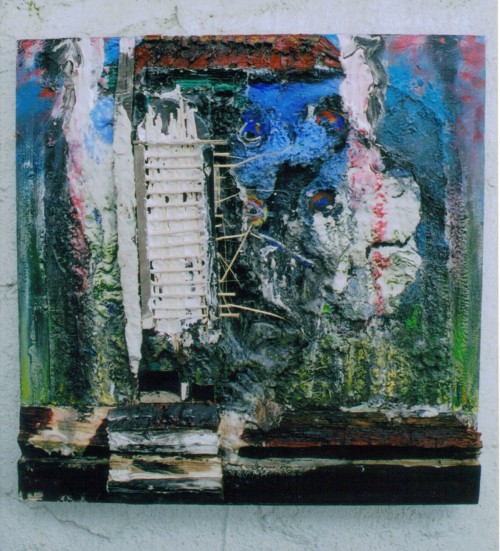
Almost like, but not exactly so. From the front line af Art: Keiffer. A Shinto Temple which I was lucky to see when in Japan. It was made completely of aged weathered wood. I came across it by chance and just stood there in reverence at the beauty of the building. The Wabi Sabi beauty of the ancient weathered object. I tried to capture that in this ‘painting’

Related Images:

Truth and a Question of Time

Where does the Truth lie: at the beginning or the end? A painting is initially a visual sensory experience and is then transformed by logic and time. So where does the Truth lie at the beginning or the end.

Here is an extract from Acharya Rajneesh: when Krishanamurti was asked once who best interprets his work he said in jest, Rajneesh. But I think they were both brothers in mind. An extract of Rajneesh’s work is:

Reason is an effort to know the unknown and intuition is the happening of the unknowable. To penetrate the unknowable is possible, but to explain it is not. The feeling is possible, the explanation is not.

When you stand in front of a painting for the first time and it creates an impact. Like a quantum scientist unable to know the true measurement of his experiment because his very act of measuring it, his intension to measure already alters the state of the experiment and hence the results. Your intension to understand that thing about the painting, as it implodes on itself perhaps and creates a connection with you and the painting, as an atom implodes on itself and alters its state with the intension to measure it. The initial raw uncorrupted Truth without the interference of time, where the logically mind then comes in with information, facts about the process and alters that initial perception. So where are you at in this: at the beginning or the end. Has art history and knowledge tainted your Truthful view of the whole. Is it a case of you initially had it, and then lost it in the end?

Related Images:

The Word Is Not The Thing

In art the quote below does not say much about art history does it? Books and books and more books as to what art is, and all those descriptions about paintings, trying to recreate the space that the artist stepped into when he made the painting. ‘The observer is the observed’, is where it is at. We tend to stand back and ‘look out’ into what we want to understand, we conceptualise, we twist and turn the Truth with time, and our minds takes that roller coaster ride of diluting the Truth, the fact through observation. And then we read more art history books attend art history courses and condition ourselves farther away from emptiness, and when we are furthest away from the Truth we, come to certain conclusions, addind to this vast knowledge of uncertainty. ‘To discover whether there is a reality or not, we must be capable of seeing the true as the true, the false as the false,…’ We must come to it as pure in mind as possible. We must come to it with no knowledge of it at all. We must come to it only by observation. We must come to it only by stepping into that space and then knowing it because it is there now with you. And not through a description, not through art history. The ‘new’ in art will only show itself when it comes this way. The new will not show itself, when the mind is still soaked in the past. And when you see that thing show itself, you recognised it, you take, and you run along with it in a series of paintings. When you are happy that it has fully manifested itself, you start looking again. Can you see if you are soaked in what is known, then all comes to a standstill and there will be no movement. And you will always be yesterday. Where is the fun in that?

Daily Quote October 6th 2007, J.Krishnamurti Foundations

Do you understand the problem, sirs? Only the mind that is free can discover what is true—discover, not be told what is true. The description is not the fact. You may describe something in the most lovely language, put it in the most spiritual or lyrical words, but the word is not the fact. When you are hungry, the description of food does not feed you. But most of us are satisfied with the description of truth, and the description, the symbol, has taken the place of the factual. To discover whether there is a reality or not, we must be capable of seeing the true as the true, the false as the false, and not wait to be told like a lot of immature children.

The description of food does not feed you—Collected Works, Vol. X (165)

Daily Quote October 7th 2007, J.Krishnamurti Foundations

So, to find out what is true, the mind must first be free, and to be free is extraordinarily hard work, harder than all the practices of yoga. Such practices merely condition your mind, and it is only the free mind that can be creative. A conditioned mind may be inventive; it may think up new ideas, new phrases, new gadgets; it may build a dam, plan a new society, and all the rest of it; but that is not creativity. Creativity is something much more than the mere capacity to acquire a technique. It is because this extraordinary thing called creativity is not in most of us that we are so shallow, empty, insufficient. And only the mind that is free can be creative.

Harder than all the practices of yoga—Collected Works, Vol. X (165)

Related Images:

Tracey Emin On The Painting Process

You know if you went deep into the Himalayan mountains and found a Mystic and asked him: please tell me where I can find the Truth and he will tell you, ‘go and ask Tracey Emin’. She tells you like it is so the process is gifted to you together with the painting. She suffers for you so you will know. Tracey Emin and Jiddu Krishanamurti, brother and sister in mind. siri.


Tracey Emin: My Life In A Column The Independant newspaper – London

‘If you’re not careful you wake up one morning to find yourself, not awake but semi-comatose’ Published: 05 October 2007

I’ve felt so much happier the last few days. My mood has lifted enormously, simply because of some late-night Saturday artistic recreation. Last week I was really struggling with my painting. I was struggling so badly that I actually hated myself. I sat in my studio feeling really morose and every brushmark felt like another tick to failure. And every ounce of residue of self-loathing and fear that I have ever experienced constantly rose and bubbled to the surface.

I was listening to David Bowie’s “Ziggy Stardust” and the lyrics: “Five years, that’s all we’ve got… five years, my brain hurts a lot…” felt as though they were smashing through my head with the power of some almighty jackhammer.

This is why I hate painting so much. I tried to get a grip on the reality of the situation.

I looked in the mirror and said to myself: “This is just completely spoilt behaviour. Monks are being shot in Burma. Women and children are being raped in Darfur. The list is bloody endless and I’m throwing a fit about the fact that I’ve just ruined three paintings.” It was like that when I was a student. I used to bang my head against my studio wall, literally, in my absolute frustration of not being able to control and manipulate the paint how I wanted to.

The worst thing is the fear. Seriously, how can someone be afraid of a paintbrush and some paint? But I am. I sit there for hours just staring at it, trying to pluck up the courage and telling myself just to go for it, do it, come on. Sometimes I cling on to part of the canvas that I feel is OK, not brilliant, just OK. OK, when everything else on the canvas is shit. And then, like Saturday and Sunday, at two in the morning, when I have been drinking and I’m painting with the arms of a poltergeist, something magic happens. It happens because I push myself to an outside area where everything is just a little bit more dangerous. It’s like jumping out of an airplane not knowing if your parachute is going to open. Really, in that situation, it’s best to treat the fall like a trip of a lifetime.

That’s what happened to me this weekend with my painting. Instead of everything being the spluttered mess of carnage, everything came together. I surprised myself and that is what art is about, or part of it. After you have been doing something for 20 years, you know what you are doing. You can close your eyes and do it and that can be soul-destroying. To muster the strength to redefine your own parameters, even in a small way, is very difficult. The mood swings, the highs and the lows of it, are quite painful, and most of the time it feels safer to be hanging out on the other side of feelings.

Faced with the daily prospects of failure and self-loathing, a numb chrysalis starts to develop around you, and if you are not careful you wake up one morning to find yourself not awake, but in a semi-comatose state, baked into a hardened shell, breathless and mind-numbing. You have to poke your finger through the hardened crispy shell, and after you’ve pushed it through you have to wiggle it about until eventually the hole is big enough to smash a whole fist through. That’s what it feels like when I’m alone in my studio trying to paint.

But today everything feels different. Today my studio is calling me. The paintings are all really happy and the paint wants to be used. It’s all spangly and exciting. There’s almost nothing that I hate, or nothing that depresses me. This is a state of mind that is created by what I make, not the other way around. To know that I will be spending the rest of my life being controlled by my own creative output is exhausting. It’s not a job, and if it were a job I would just do it, I would just get up and do it.

I’m not moaning. I’m trying to explain how it is. And there is a lot of pressure involved. Every exhibition, every show, builds up into some almighty crescendo, almost as if your brain is going to explode. It’s not just the pressure of the deadline, but the battle to recreate and justify the things that you make. The world is full of so much stuff. Every second, every moment, things are rolling off a production line; our minds, our space, continually being contaminated with more and more things. That’s why the justification is difficult.

What makes art more worthy, or what makes art, art? I would like boldly to say that it’s the decision of the artist. That’s true at the beginning, but of course that truth becomes mutated by the views of others. It’s like the work of art has been ripped away from the artist and sails through the ether like a giant boomerang until it eventually returns home to the artist. I really feel like this about My Bed . The art goes out into the world and becomes so attacked that you feel that you have to defend it and protect it, as though it’s almost human. But the strange thing is, a seminal work of art is actually much bigger and much stronger than the artist who made it. The idea will the eclipse the artist in their lifetime. So it’s actually the art that protects the artist.

That’s the way that I feel today. I feel that my art is looking after me, keeping me buoyant and well and truly alive.

Related Images:

The Magic Of A Good Song

There is a quest in all artist to find the Truth in a composition. There is always a time when a painting comes together. And when it falls into place after a struggle to find form, at just that moment there is an intangible Truth that you are part of. You have stepped into a space unknown to you before. And in the spirit of things there is a driving force that takes you further with each painting. It just might be that the magic of a good song is not with total harmony or with total chaos, but somewhere in between. With each painting, there is something askew in the composition, something slightly off total harmony yet not all chaos, something caddish, that stirs you up, stops you so you want to find out more. Like the properties of an atom alters when you interact with it and hence its true state can never be measured, so it is with a good painting, when you stand before it, it and you are entangle in a visual Truth of the universe: it shows you this is how the vast universe and you co-exists as one. Below K shows how that moment can be found everywhere when the Truth is manifested and falls in place and observation will show you that perfect moment.

Related Images:

“A mind conditioned by a system can never see the truth”

Daily Quote September 22nd 2007, Krishnamurti Foundations

You can see that those who pursue a system, who drive the mind into certain practices, obviously condition the mind according to that formula; therefore, the mind is not free. It is only the free mind that can discover, not a mind conditioned according to any system, whether Oriental or Occidental. Conditioning is the same, by whatever name you may call it. To see the truth, there must be freedom, and a mind that is conditioned according to a system can never see the truth.

A mind conditioned by a system can never see the truth—Collected Works, Vol. VI (211)

Related Images: