Ai, abundance, and the quiet end of the spiritual search
Human history can be read as a long series of triggers. Each trigger catches the brain–mind at the right moment and pulls it into a new phase of becoming. From survival to cities, from fire to machines, from energy to information, every leap has been less about tools themselves and more about how the mind reorganises around what those tools promise. Now, as artificial intelligence begins to mirror the very process of thinking, we may be approaching the final trigger, not of more becoming, but of seeing becoming itself.
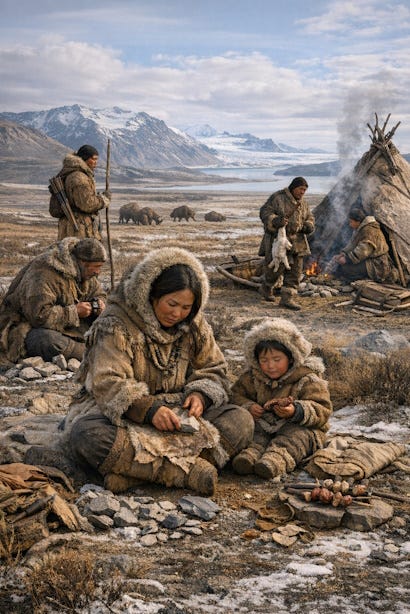
For most of human existence, life unfolded slowly. The brain–mind was organised around immediate needs, finding food, keeping warm, staying alive, holding a small social world together. The loop of becoming was simple and local. Each day began where the last ended. Progress existed, but it moved at the pace of seasons and generations. The trigger was survival, and survival alone was enough to keep the system running.
Then, gradually, the environment began to offer new hooks. Agriculture appeared, and with it the idea of stored time. Grain was not just food; it was the future made visible. The mind learned to live ahead of itself. Ownership, planning, hierarchy and debt all followed naturally, not as inventions, but as structural responses to a world where tomorrow could be controlled.
Trade came next. Salt, spices, metals, rare stones. Suddenly, value was no longer just in use, but in exchange. The brain–mind discovered that symbols could stand in for things, and that control of flow could replace control of land. With trade, the becoming process learned to stretch across distance. The world grew larger inside the mind.
Then energy was unlocked. Coal first, then oil. For the first time, human intention could be amplified far beyond muscle and wind. Stored sunlight from deep time was burned to move machines, and machines began to reshape everything. The Industrial Revolution was not just mechanical. It was cognitive. The mind saw that with enough energy, any pattern could be forced into reality. Speed itself became a value.
Capitalism did not arrive as an ideology. It emerged as a natural extension of this loop. If the brain–mind is driven by prediction and reward, then a system that turns prediction and reward into numbers will scale without limit. Profit became an external dopamine circuit. Growth became its own justification. The becoming process found a way to reproduce itself at civilisational scale.
Cities followed, almost inevitably. They organised themselves like minds made of stone and steel. Roads became pathways of flow. Markets became synapses of exchange. Power grids pulsed like metabolism. Information moved like signals across a nervous system. The cityscape was not just where people lived. It was the brain–mind written across the land.
Through all this, the triggers kept coming from outside. More resources. More energy. More speed. More reach. Each time, the system adapted, grew, and carried more residue forward. Each time, the sense of self expanded with the world it could now control.
And now, something different appears.
Ai is not just another machine. It is the externalisation of the cognitive loop itself. Pattern recognition, prediction, learning, feedback, decision. The very mechanics that assemble experience in the brain–mind are now being mirrored outside it. For the first time, the mind is not just extending its power into the world. It is seeing its own structure reflected back at it.
This is why this moment feels different. Fire did not ask us what we are. Steam did not question the nature of thought. Electricity did not mirror perception. But Ai does. It quietly asks, if this process can be replicated, then what am I beyond this process?
Here, the trigger changes character. It no longer points outward to more control. It points inward to the mechanism of becoming itself.
At the same time, voices like Elon Musk speak of a future where automation ends most work, where AI produces abundance, and where a high-value basic income frees people from survival labour. In practical terms, this means the oldest trigger of all, the need to work in order to live, may begin to dissolve. The external pressures that kept the loop of becoming tight and urgent could loosen.
If that happens, humanity will face a condition it has rarely known at scale. Not scarcity, but space. Not demand, but freedom.
And that is where the deeper question emerges.
When nothing is demanded of you to survive, what does your mind do with itself?
For individuals, this question has always been the heart of spirituality. When suffering becomes visible, when striving exhausts itself, the search turns inward. Not to find a better world, but to understand the process that keeps generating the sense of a self in a world. Buddha, Krishnamurti, and many others pointed not to new beliefs, but to seeing the machinery of mind and letting it fall silent.
What is new now is not the insight, but the scale. Ai may bring this confrontation to civilisation itself.
If machines can do what thinking does, then thinking loses its mystery. If systems can predict and decide, then the authority of thought weakens. What remains is not more becoming, but the question of being. The question of what is left when the loop is seen through.
In this light, Ai becomes the last great trigger. Not a trigger for expansion, but for completion. Not for more power, but for understanding the source of power. Not for new identities, but for seeing how identity is assembled moment by moment.
Of course, nothing guarantees this will be graceful. The same mirror can become the ultimate distraction. Ai could deepen craving, automate control, flood attention, and keep the loop of becoming spinning faster than ever. The residue could grow, not dissolve. The city of mind could become a labyrinth with no exit.
So the moment is a fork.
Ai can become the final engine of becoming, or the mirror that reveals becoming.
If it becomes the mirror, then the spiritual process, as history has known it, may reach its natural end. Not because truth is found, but because the mechanism of searching is understood. Spirituality would no longer be a path, a practice, or a hope. It would become the simple recognition of how experience resets, how the self is built, and how clean collapse leaves nothing to carry forward.
In that sense, the end of work and the rise of Ai are not just economic shifts. They are existential ones. They remove the outer triggers and leave the inner loop exposed.
And perhaps that is what this age is really about.
Not the triumph of machines.
Not the conquest of nature.
But the mind, finally seeing itself, and standing at the edge of asking whether it still needs to become at all.
Reference: The article was triggered by information in the link below.
At Rimrock Draw Rock Shelter in Oregon, archaeologists uncovered stone tools and animal remains dating back more than 18,000 years. Radiocarbon dating of camel and bison teeth confirms human presence well before the Clovis culture. The discovery adds to growing evidence that humans reached North America much earlier than once believed and suggests many older sites may still lie buried beneath later sediments.