Everlastingly Becoming

Daily Quote September 19th 2007, Krishnamurti Foundations

So, the mind is everlastingly seeking to be something, and thereby increasing its own sense of power, position, prestige. From the urge to be something springs leadership, following, the worship of success; and hence there is no deep individual perception of inward reality. If one actually sees this whole process, then is it possible to cut at the root of one’s search for power? Do you understand the meaning of that word power? The desire to dominate, to possess, to exploit, to depend on another—all that is implied in this search for power. We can find other and more subtle explanations, but the fact is that the human mind is seeking power and, in the search for power, it loses its individuality.

From the urge to be something springs leadership – Collected Works, Vol. IX (274)

Related Images:

Lost In Space Or Duty Of The Image

This new painting (September 2007) really takes off an earlier style. Something about style that you cannot take away from an artist as it is always inherently himself. You always come back to it, to himself/herself. The final copy comes from chance, spontaneity, and at the end a certain kind of logic. There is an intuitive feeling of your way to the final composition. Here, I have in this painting, compromised with what I thought would be appealing to the viewer in that I gave him/her space which I think visually always, to me, takes away from the universal Truth of the duty of the image and that is to bring one to a new unknown space, yet here I give you the past and what you are conditioned too. I know you will recognise it, the meditative quality to a great abstract painting, will be lost in space.

Related Images:

It Is Only A Confused Mind That Chooses

Daily Quote September 17th 2007, J.Krishnamurti

It is one of the fallacious concepts that man is free. Of course, man is free to choose, but when he chooses he is already in confusion. When you see something very clearly, then you do not choose. Please look at this fact in yourselves. When you see something very clearly, where is the necessity of choice? There is no choice. It is only a confused mind that chooses, that says, “This is right, this is wrong, I must do this because it is right,” and so on, not a clear precise mind that sees directly. For such a mind there is no choice. You see, we say that we choose and therefore we are free. That is one of the absurdities we have invented, but we are not basically free at all. We are conditioned, and it requires an enormous understanding of this conditioning to be free.

We are not basically free at all – Collected Works, Vol. XVII (270)

Related Images:

“your consciousness, your reality, is an illusion”—So What’s Real In A Painting?

What’s going on in the brain?

A scientist has revealed that it’s much more than we’ll ever know. Kate wighton reports.

“Your brain operates on a need-to-know basis and most of the time you don’t need to know.” This is how professor chris frith, a neuro-psychologist from university college london, sums up the relationship between our brains and our minds.

And he puts forward a mind-boggling prospect: The majority of the work that your brain does goes on unconsciously. In fact, your whole world, your consciousness, your reality, is an illusion, created by our brains, every one of which constructs them slightly differently…

Related Images:

You Either Think It Or Be It

Daily Quote September 12th 2007, Krishnamurti Foundations

You have to find out for yourself, and not wait for me to tell you, whether the mind can ever be free. Can the mind only think about freedom, as a prisoner does, and so is doomed never to be free but always to be held within the bondage of its conditioning?

Can the mind only think about freedom, as a prisoner does? The Collected Works, Vol. X (166)

What form will a composition take when it is painted by a totally free mind. This is not necessarily an impossibility, if the mind is only for an instant free, when it is completely focused.

When you passionately pursue the Truth, or deep in ‘meditation’, super focused when painting, looking, making, observing, hoping: there are times when the mind is in a state of one-pointedness, that the past is not present, he forgets his conditioned self, and the painter inhabits a space that is pure, and his insight is new and this will show up in his composition. You will know it when you see it. Because it will be somewhat quirky,messy at times as the mistakes are left behind, as the moment follows through quickly, no time for the thinking mind to correct the mistakes, there will be spontaneity, chance findings, building on that chance finding, all happening quickly, and it comes to an end, and the thinking mind looks at what it has done, the mind sits back, ponders on what had just happened, the painter does not remember where he had just been, he was in a state of pure observation, it all happened where time did not exists, and perhaps because of that it was not recorded in his mind and hence not remembered. siri.

Note: According to the renowned German scholar Max Mueller, the study of mental states is unique to India. He also opined that ekagrata or one-pointedness that India spoke of was unknown, and to a large extent, incomprehensible to the Western world. And this viewpoint holds true even today.

Related Images:
So What Is ‘NEW’

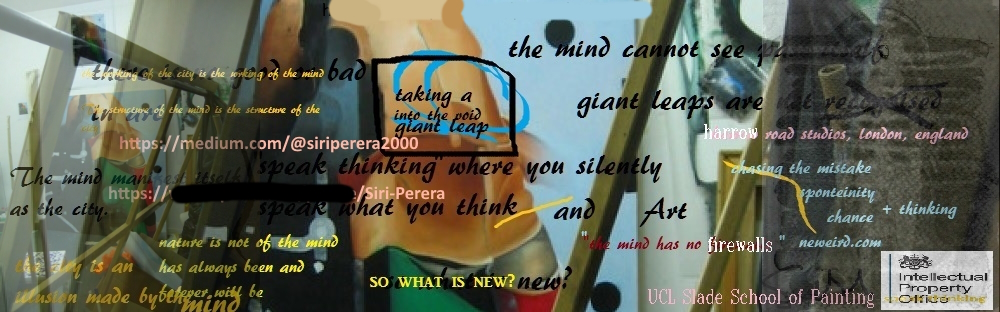
There is always somebody not very far away from what you are doing. There are 2 types of new: new that is new to you or the new that is universally new, that is new to the frontline of Art. What is important is that what you do is universally new. It adds to the movement forward of Art. So how is new defined. It is a gradual unfolding of what’s new. Perhaps 60% of what is already there and 40% of new form/ideas on the canvas. So is it OK to take some from what’s already there ( both personally and universally) and add to it to make the new. If it is not just like, but different with some new elements, then I think it is OK. For it is not only about him, or me but it is about all of us, to be able to step into a space of the NEW for everybody.

Related Images:

“Only stillness speaks”

India and the National Value of Art

I would like to say something about his little booklet I picked up when I was visiting Auroville in Pondicherry in India. It is called ‘The National Value Of Art’, by Sri Aurobindo. What caught my eye was that this booklet was first published in six instalments in a magazine in November and December 1909. This was the time between 1890 to 1920 when Art went through a transition from realism to abstraction where Kandinsky played an important part. Kandinsky’s ‘Concerning the spiritual in Art’, was published in around 1912. The whole world was involved in that transition. Auroville was an interesting place to stay in. It was truly a universal township. It was devoted to human unity. I met people from all around the world who had come to stay in Auroville permanently. They had recently completed a meditation hall, which contained the biggest man-made crystal in the world. There was a tracking system that tracked the sun as it travelled east to west so the sun’s rays would focus on the crystal at all times. The crystal was in the centre of the globe and all meditators sat around it to meditate. You could hardly hear a pin drop from inside the dome, and all you could hear was your mind ticking away. Endlessly. Tick tick. Non stop. This or that and everything. Just ticking away. It was annoying to ‘hear’ your own mind. Nothing comes from this noisy mind but confusion. ‘Only stillness speaks,’ as they say. One has to learn to work from that, ‘nucleus of calm.’


Continue reading

Related Images:

We Worship Technique/Talent

From the book “The Courage to Create” by Rollo May

The fact that talent is plentiful but passion is lacking seems to me to be fundamental facet of the problem of creativity many fields today, and our ways of approaching creativity by evading the encounter have played directly into this trend. We worship technique—talent—as a way of evading the anxiety of the direct encounter.

Kierkegaard understood this so well! “The present writer …” he wrote about himself, “can easily foresee his fate in an age when passion has been obliterated in favor of learning, in an age when an author who wants to have readers must take care to write in such a way that the book can easily be perused during the afternoon nap.”

Related Images:

“in freedom alone can there be creativeness”

“Creativeness Through Self-Knowledge”—The Book of Life by Jiddu Krishnamurti

…There is no method for self-knowledge. Seeking a method invariably implies the desire to attain some result and that is what we all want. We follow authority—if not that of a person, then of a system, of an ideology—because we want a result that will be satisfactory, which will give us security. We really do not want to understand ourselves, our impulses and reactions, the whole process of our thinking, the conscious as well as the unconscious; we would rather pursue a system that assures us of a result. But the pursuit of a system is invariably the outcome of our desire for security, for certainty, and the result is obviously not the understanding of oneself. When we follow a method, we must have authorities—the teacher, the guru, the savior, the Master—who will guarantee us what we desire; and surely that is not the way to self-knowledge.

Authority prevents the understanding of oneself, does it not? Under the shelter of an authority, a guide, you may have temporarily a sense of security, a sense of well-being, but that is not the understanding of the total process of oneself. Authority in its very nature prevents the full awareness of oneself and therefore ultimately destroys freedom; in freedom alone can there be creativeness. There can be creativeness only through self-knowledge.

Related Images:

Art? No Thing!

From the Book: Art? No Thing!: Analogies Between Art, Science and Philosophy—By Fre Ilgen

There is only one way that can lead you to understand life and reality: your own way.

Trusting your intuition, experience and theory helps you find your way. Artists find their way through making works of art. Painting, sculpting, etc. is their thinking on life and reality. Theory and knowledge of other fields enhance the understanding of their own way.

The experience of art will enhance your intuition and acknowledgment of life and reality as it is.

Fre Ilgen

Related Images: