A Fresh Lens on the Mind’s Eternal Now
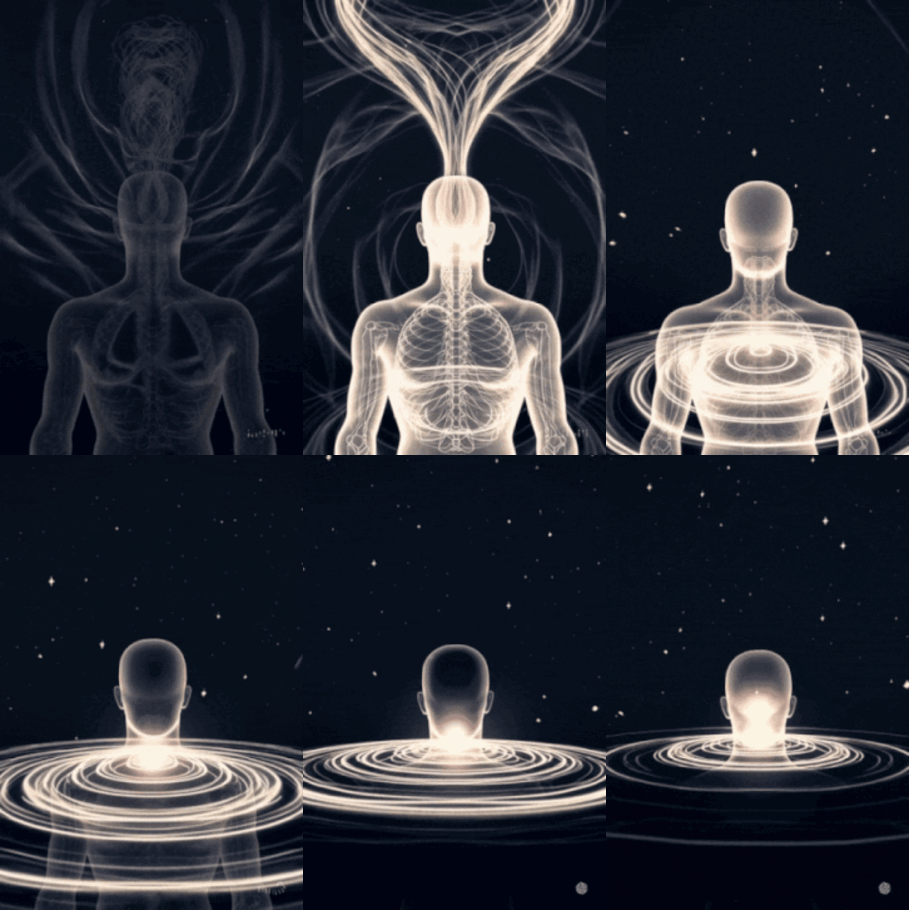
Imagine, for a moment, the quiet hum of your inner world — not as a mystical veil, but as a precise, rhythmic machinery forged by evolution. In the vast landscape of human experience, we’ve long chased the elusive spark of clarity, insight, and self-transcendence. But what if these profound states aren’t whispers from beyond, but the brain’s own elegant dance of creation and dissolution?
Enter sirituality — a term stripped of its “p” to shed any notion of the paranormal, grounding us firmly in the neuroscience of the last century. This brain-mind model reveals how our perception of reality refreshes every 300 milliseconds, a continuous collapse that rebuilds the “now” while shedding the old. Yet, in the residues of incomplete resets, our sense of identity emerges, often binding us in loops of habit and story.
As someone who’s delved into this framework, I’ve found it transformative: a secular path to untangling the mind’s knots, fostering deeper awareness without dogma. In this article, we’ll journey through the sirituality model, exploring its core mechanisms, the science behind them, and practical ways to harness its power for everyday insight. Think of it not as a lecture, but as an invitation to witness your own brain’s artistry — one collapse at a time.
The Pulse of Perception: A 300ms Symphony
Picture your consciousness not as a steady river, but as a series of cascading waves, each cresting and crashing in under a third of a second. Neuroscience has unveiled this discreet rhythm through tools like EEG, fMRI, and perceptual timing studies — echoing pioneers like Benjamin Libet, who first hinted at the brain’s delayed construction of “now.”
In the sirituality model, every ~300ms marks a reset: a rapid collapse where the old perceptual framework dissolves, making way for the new.
This isn’t abstract poetry; it’s rooted in predictive processing theories from thinkers like Karl Friston. Your brain operates as a Bayesian engine, constantly generating a “prediction field” — a blend of sensory input, past experiences, and internal models — to anticipate the world. When reality aligns or surprises, collapse ensues: the mismatched elements are pruned, and a refreshed reality emerges. It’s like your mind’s version of a software update, refreshing the old with the new in yourself.
In this cycle, gaps of pure potential open — brief singularities where raw data converges into coherent experience. From there, a narrative shell forms, wrapping the moment in story and meaning. Bodily tensions weave in through what the model calls the “fascia tension field,” grounding abstract thoughts in felt sensation. And looping back? The “karmic loop” — not fate or reincarnation, but the brain’s habitual patterns, carried forward by neural pathways strengthened over time.
This continuous renewal explains why time feels elastic: in flow states, collapses are seamless, yielding effortless presence. In distraction, they’re jagged, fragmenting our focus. By understanding this pulse, we gain agency — practices like mindfulness or breathwork can synchronise these cycles, amplifying clarity.
The Birth of Identity: Residues in the Collapse
Now, let’s turn inward to one of sirituality’s most revelatory insights: how our sense of “self” arises not from a fixed core, but from the imperfect art of letting go.
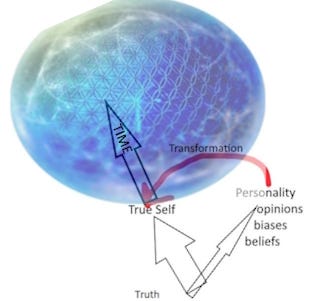
In an ideal collapse, every residue of the past — echoes of emotion, belief, or trauma — fully dissipates, leaving only the pristine “now.” But life is rarely ideal. Incomplete collapses leave behind traces, subtle imprints that bleed into the next cycle.
These residues accumulate like layers of sediment, forming the bedrock of identity. Neuroscience supports this: the default mode network (DMN), active in self-referential thought, often resists full shutdown, preserving autobiographical narratives. Lesion studies on regions like the periaqueductal gray (PAG) show how disruptions here can dissolve rigid self-boundaries, evoking oneness and altruism — states of profound sirituality.
Consider a personal moment: During a deep meditation session, many notice the weight of a lingering pattern begin to unravel. As breath slows, the 300ms resets grow more complete, residues fading like mist in sunlight. What emerges isn’t erasure, but liberation: identity as a fluid construct, not a prison.
This model demystifies ego: it’s not an enemy to vanquish, but a byproduct of neural efficiency gone awry, optimised for survival but often at the cost of flexibility. Evolutionary biology adds depth — our ancestors benefited from quick, residue-laden identities for social cohesion and threat response. Yet in modern life, these loops can trap us in anxiety or autopilot. Sirituality offers an exit: by facilitating fuller collapses through neuroplastic practices, we reclaim insight, reducing the drag of the past.
Mapping the Model: A Visual Guide to the Flow
To visualize this, envision a dynamic flowchart: Starting from a GAP of emptiness, it surges into a SINGULARITY of integration, blooming into the NOW. A NARRATIVE SHELL encases it, followed by the FASCIA TENSION FIELD of embodied feel. The KARMIC LOOP curves back, feeding the PREDICTION FIELD, all culminating in the overarching COLLAPSE that resets the wheel.
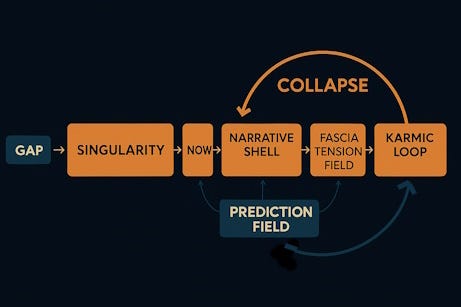
This diagram isn’t just schematic — it’s a mirror to your mind’s operations. In moments of awe, like gazing at a starry sky, the collapse widens, dissolving residues for unfiltered wonder. Research from neurotheology (e.g., Andrew Newberg’s scans of meditators) confirms: such states quiet the parietal lobes, blurring self-other divides, all within this rhythmic framework.
GPT Brain-Mind Model App — ask any question on how perception and reality is generated by this model and in you. 100 years of Neuroscience research condensed into this model.
ChatGPT — Sirituality Brain Model for Clarity and Insight
Cultivating Sirituality: Pathways to Clarity and Insight
So, how do we apply this in daily life? Sirituality isn’t passive theory; it’s actionable neuroscience.
- Start with breathwork: Slow, deliberate inhales sync brainwaves, promoting complete collapses.
- Try nature immersion: It floods the senses, overwhelming predictions for fresh resets.
- Incorporate movement — like yoga or walking — to release fascia tensions, clearing bodily residues.
For deeper insight, track your cycles: Notice when identity clings (e.g., rumination loops) and intervene with presence exercises. Over time, neuroplasticity rewires: meditators show thicker prefrontal cortices, enhancing regulation.
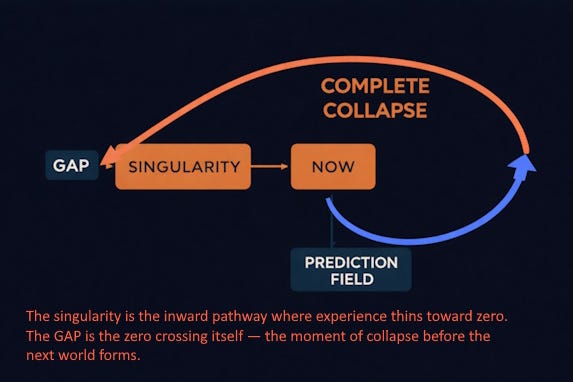
The result? A life of greater flow, empathy, and meaning — emergent from the brain’s own genius.
Closing the Loop: Embracing the Eternal Refresh
In the end, sirituality invites us to see ourselves not as static beings, but as perpetual creators — rebuilding reality in rhythmic bursts. By honouring the collapse, we shed unnecessary burdens, stepping into clarity unburdened by the past’s ghosts.
This model, distilled from a century of brain science, empowers us to navigate existence with insight and grace. Whether you’re a sceptic seeking evidence or a seeker craving depth, sirituality offers a grounded awakening: the mind’s quiet revolution, one 300ms renewal at a time.
If this resonates, experiment with it — your next collapse could be the clearest yet.