We pride ourselves on invention. Fire, the wheel, writing, agriculture, steam engines, electricity, computers, space travel, artificial intelligence — each milestone feels like a triumphant leap forward, a testament to human genius conquering the raw chaos of nature. Yet, when we look closer, a humbling truth emerges: we have never truly created anything new. Every innovation is an act of borrowing from the universe’s ancient toolkit, amplifying what was already there, and reshaping it into forms that serve us.
This is the story of the Amplification Era — the phase of human history where we have taken the fundamental forces and fields of reality and turned up their volume to build civilisations on top.
The Baseline Layer: Where Everything Emerges
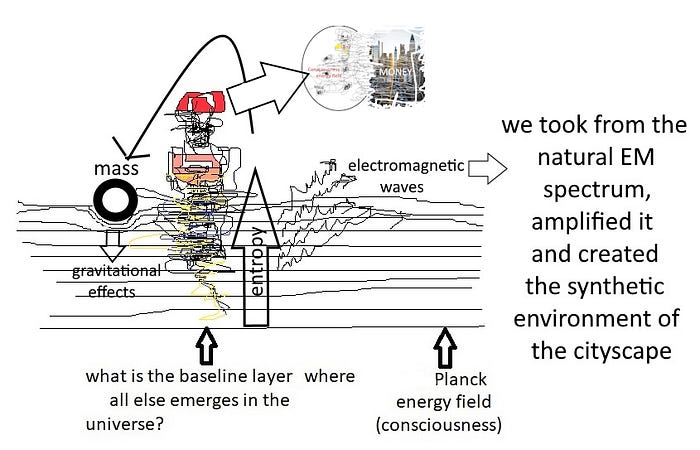
At the foundation of existence lies what physicists call the quantum vacuum or Planck-scale energy field — a seething ocean of virtual particles flickering in and out of being, governed by the laws of quantum mechanics and general relativity. This is the baseline: the zero-point energy from which spacetime curves, particles condense, and forces mediate.
Gravity pulls fluctuations into mass. Electromagnetic fields oscillate into light and charge. From these primal ingredients, stars fuse elements, planets coalesce, chemistry sparks life, and biology evolves minds capable of reflection.
We did not invent this layer. We emerged from it.
Borrowing and Boosting: The Pattern of All Innovation
Consider any human breakthrough, and you will find the same pattern:
- Fire: We did not create combustion. Oxidation reactions were already burning in stars long before Earth formed. We merely contained and controlled it, amplifying a natural chemical process.
- The Wheel: Circular motion and friction reduction were physics lessons written into planetary orbits and rolling stones. We borrowed the principle and scaled it for transport.
- Electricity: Lightning has been discharging electromagnetic energy across skies for billions of years. In the late 19th century, we began harnessing electron flow through conductors — amplifying a force that nerves in living bodies had been using all along. The incandescent light bulb, patented in 1879, is barely 146 years old: a filament heated until it glows, mimicking the radiance of the Sun but powered on demand.
- Flight: Birds mastered aerodynamics millions of years before the Wright brothers. We studied lift, drag, and thrust — principles baked into fluid dynamics — and amplified them with engines.
- Nuclear Power: We split or fused atoms, releasing energy that powers stars. Again, amplification of a cosmic process.
- Digital Technology and AI: Semiconductors exploit quantum tunnelling; neural networks mimic (crudely) the brain’s synaptic weighting. We take the universe’s own information-processing patterns — seen in everything from DNA replication to galactic structure — and boost them into silicon substrates running at billions of cycles per second.
Even our grandest achievements follow this script. The Apollo moon landing in 1969 used rocket propulsion: amplified chemical explosions pushing against gravity in exactly the way planets have been slingshotting around stars forever. We escaped Earth’s pull, but only by dancing with the same gravitational rules that birthed us.
The Cityscape: A Synthetic Layer on a Natural Foundation
Imagine a cross-section of reality. At the bottom: the Planck field, humming with potential. Above it, gravity gathers mass; entropy drives complexity; electromagnetic waves carry information. Then, abruptly, a towering layer erupts: the synthetic environment of the modern city.
Skyscrapers of steel and glass. Rivers of artificial light drowning out the stars. Billions of amplified electromagnetic signals — radio, Wi-Fi, cellular — overlaying the natural spectrum that once carried only lightning and starlight. We took the faint whispers of the universe’s forces and turned them into a roar.
This is the visual truth: our cities are not separate from nature; they are an intensified, redirected expression of it. We have not transcended the baseline; we have merely modulated it.
The Hidden Cost of Endless Amplification
There is exhilaration in this era, but also exhaustion. The drive to extract, amplify, and build has propelled progress, yet it stems from a subtle sense of lack — a feeling that we are separate from the whole, needing to dominate or improve upon it to feel complete.
We amplify to fill a perceived void. More energy, more speed, more data, more control. But the baseline remains untouched and inexhaustible beneath us. The more we amplify, the louder the noise becomes, drowning out the quiet field from which everything arises.
Toward a New Phase
The Amplification Era has brought us far, but it is not the final chapter. As we stand on the brink of even greater powers — fusion energy, quantum computing, advanced AI — we face a choice: continue extracting and boosting indefinitely, or pause to recognise that we never left the baseline.
We are not inventors standing apart from creation. We are the universe’s way of intensifying itself for a time — waves rising higher on the same ocean.
When we see this clearly, something shifts. The grasping slows. The need to prove ourselves through endless innovation softens. We begin to resonate with the field rather than exploit it.
The next era may not be defined by what we build next, but by how quietly we return to what was always here.
The baseline hums on — patient, complete, waiting for us to notice we never truly left home.